
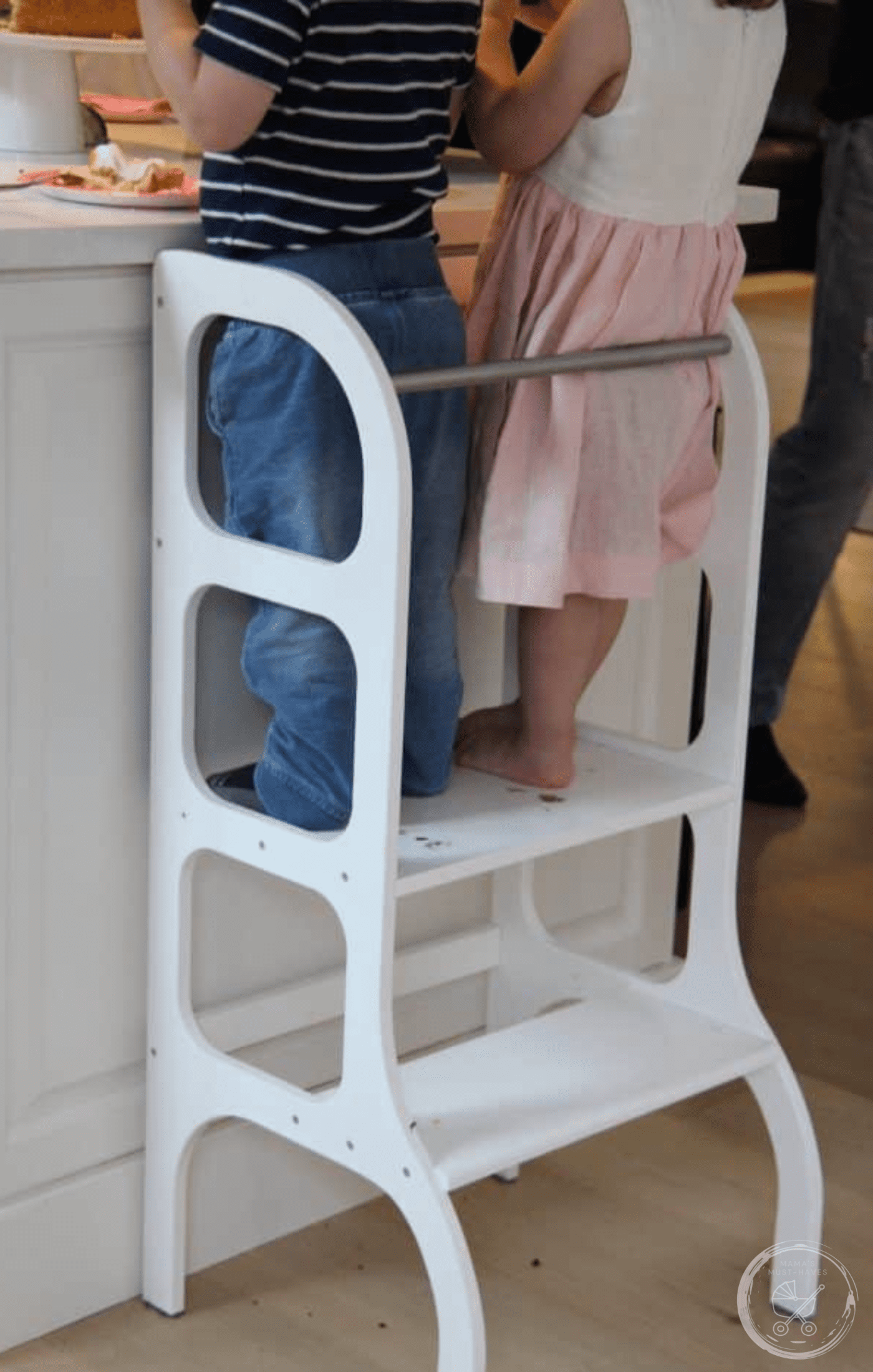
The helping tower is the single most-used piece of furniture in our house. It gets pulled out every morning and rarely gets put away before bedtime. My mom spotted one on Instagram and passed along the recommendation, and I ordered it shortly after. Now both of my kids have one, and they use them constantly.
If you have a toddler and you spend any time in the kitchen, this is worth knowing about. Here is everything I have learned from actually using a helping tower day after day.
What is a helping tower?
A helping tower, also called a learning tower, is a piece of wooden furniture designed to bring a toddler up to counter height safely. It looks a bit like a step stool, but it has four sides and a raised platform, which makes it much more secure. One side is typically an open bar rather than a solid panel, so children can climb in and out easily without feeling trapped.
The original learning tower was created by Little Partners, a company founded by a Montessori educator named Carol Gamble. Their design has a Greenguard Gold Certification, which means it has been tested for chemical emissions. Many of the towers on the market today are based on that original design.
A helping tower is not the same thing as a step stool. A step stool has no sides, which means a child can step off the edge at any point. A helping tower surrounds the child on all four sides, so they have support while they stand and work. That extra security is what makes the difference at a kitchen counter.
Why a helping tower is worth it
Toddlers want to be involved in what you are doing. They want to see the counter, stir the bowl, and watch the water run from the tap. The helping tower makes that possible without you holding them on your hip or watching them wobble on a step stool.
For us, the benefits have been practical and immediate. My daughter eats breakfast standing in her helping tower. She does Play-Doh there. We have done science experiments there. She helps with food prep, watches me cook, and uses it as her spot for crafts and snack time. She climbs in voluntarily, which tells you a lot about how much she likes it.
The design fits well with a Montessori kitchen setup, where the goal is to give children real access to real activities. Instead of watching from the side, a child in a helping tower is right there at counter level, participating alongside you. That independence matters to them, and it makes daily routines smoother for everyone.
Most helping towers can accommodate children as young as two years old, with supervision. The enclosed platform means they are not going to suddenly step backward off an edge. As with any piece of furniture, you still want to stay nearby, but the design removes a lot of the risk that comes with a standard step stool.
What to look for when buying one
Not every helping tower is the same. A few features are worth paying attention to before you buy.
Adjustable height
Some towers have a fixed platform height, while others offer two, three, or even four height settings. An adjustable tower grows with your child and stays useful for longer. The towers we have are not height adjustable, which is fine for now, but I would look for that feature if I were buying again today.
Size and storage
Helping towers are made of solid wood, so they take up real floor space. If your kitchen is small, look for a foldable model. Several brands make towers that fold flat for storage, which makes them much easier to tuck away when not in use.
Weight limit
Check the weight limit before purchasing, especially if you have two children close in age who might want to share. Some towers can accommodate more than one child, but you need to confirm the specs first.
Certification
The Little Partners tower carries a Greenguard Gold Certification. If you are buying from a different brand, look for similar safety certifications or read reviews carefully to assess the build quality.
Add-ons and accessories
We use our helping tower as-is and have not needed extras, but a few add-ons are worth mentioning if you want more.
A non-slip mat placed under the tower prevents it from sliding on hardwood or tile floors. This is a simple and inexpensive addition that adds stability, especially when a child is climbing in and out.
Some parents use safety nets, sometimes called Kitchen Helper Keepers, for added security. These attach around the open side of the tower and give extra peace of mind for younger or more active children.
Some tower models also come with an activity board or writing surface attached to one side, which turns the tower into a small workstation for drawing and early writing practice. If you are handy with a sewing machine, you could also make a fabric activity panel to attach to your existing tower.
When a helping tower might not be the right fit
A helping tower works well for most families, but it is not the right tool for every home. If your kitchen is very small, a full-size solid wood tower may simply take up too much floor space. In that case, a foldable model is the better option, not a reason to skip it entirely.
Some parents worry that a helping tower will encourage their child to climb on other furniture. That is a fair concern for some toddlers. With consistent guidance, most children learn that the tower is their place to stand and work, not a launching point for other adventures. It takes a little practice, but it comes with time.
If your child is under two, you may want to wait a few months before introducing a helping tower. Most are designed for children who can climb steps and stand steadily on their own.
How it fits into a Montessori home
The helping tower is one of the most practical pieces of Montessori furniture you can add to a family home. The whole idea behind Montessori design is giving children real access to their environment, not a simplified or toy version of it. A helping tower does exactly that in the kitchen.
It pairs naturally with other Montessori home setups, where the goal is for children to participate in daily life at their own level. Cooking, washing, pouring, and preparing food are all real tasks that children can practice from a young age when they have the right tools. The helping tower is that tool for the kitchen.
If you are new to Montessori ideas at home, the helping tower is a good place to start. It is concrete, practical, and immediately useful. You do not need to overhaul your whole house to benefit from it.
Our experience, honestly
My dad built a second helping tower by hand for our second child after seeing how much the first one got used. That tells you something. When a grandparent decides to build one from scratch, you know the original made an impression.
Both of my kids use their towers every day. They bring them to wherever the action is in the kitchen. They eat at the counter, help with prep, and do their crafts there. We barely use a step stool anymore. The step stool is still there, but it mostly collects dust.
The one thing I would change if I were starting over is buying an adjustable-height model from the beginning. Our towers work well at the current stage, but adjustable platforms would extend the useful life of each one. If that matters to your family, look for a model with at least three height options.
For more ideas on setting up your home to support your child’s independence and curiosity, take a look at the Montessori playroom guide or browse through activities for toddlers that work well alongside a helping tower setup.




Leave a Reply