
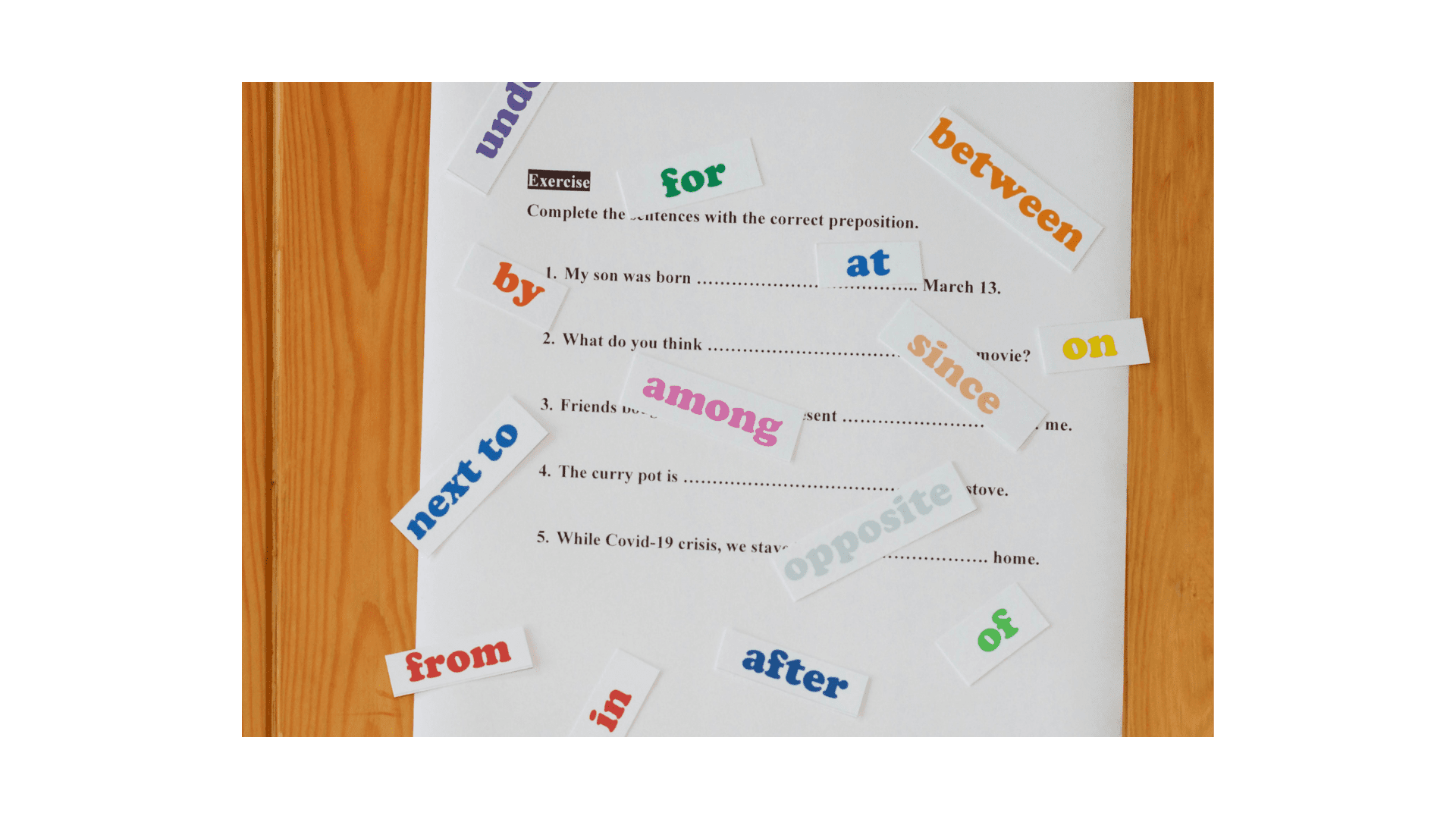
Prepositions are the small words that connect nouns, pronouns, and noun phrases to the rest of a sentence. They describe place, location, direction, and relationship. Prepositions of place, in particular, get a lot of attention in kindergarten. Children this age are actively building the language they need to describe the world around them, and these words are central to that.
This post covers practical resources for teaching prepositions of place to kindergarteners. You will find books, songs, videos, games, worksheets, and hands-on activities. Different children learn in different ways, so I have included a range of options to fit different learning styles.
What prepositions of place are
Prepositions of place are words like in, on, under, beside, between, behind, and above. They tell us where something or someone is in relation to something else. A child might say “the ball is under the chair” or “I sit beside my friend.” These words show up constantly in everyday speech.
Most kindergarteners have already been using prepositions for years before they formally learn them. Phrases like “I eat at the table” or “we play in the yard” are natural parts of how young children talk. The goal at the kindergarten level is to help children recognize these words and use them with more intention and accuracy.
If you want to build a strong foundation for your child’s reading and writing, prepositions of place are a great starting point. They come before prepositions of time in most early literacy sequences. Once children have a solid grasp of place, you can move on to more abstract time-related language. You can read more about building that foundation in our early literacy tips for parents post.
Books about prepositions of place
Books are one of the most effective ways to introduce this concept. A good picture book uses repetition and illustrations to show prepositions in context, which makes the meaning easier to grasp than a definition alone.
If You Were a Preposition by Nancy Loewen is a clear and simple introduction to prepositions for young readers. Under, Over, By the Clover: What is a Preposition? by Brian P. Cleary uses rhyme and humor to make the concept stick. Around the House the Fox Chased the Mouse by Rick Walton is another fun option that weaves prepositions naturally into the story.
If you cannot get to the library right now, many of these books are available on YouTube read aloud. A search for the title will usually turn up a read-aloud version within seconds. Under, Over, By the Clover by Brian P. Cleary, read by Time2Read2Us, is one that works well for this.
Songs and videos for learning prepositions
For children who learn well through music and movement, songs are a highly effective tool. Jack Hartmann has a popular preposition song that is catchy and easy to follow along with. Scratch Garden also has a “Prepositions Song” that comes in three parts and holds attention well.
If your child enjoys animated stories, look up “The Frightened Little Rabbit” by Teacher Joan on YouTube. It is a short animated video that uses a story format to show prepositions of place in action. You can skip to the 2:15 mark to go straight to the story.
Games that teach prepositions
Play-based learning works well for prepositions because the vocabulary gets used naturally as part of the game. Children hear and say the words repeatedly without it feeling like a lesson.
Group games
One fun group game works like a movement activity. The leader calls out a group, such as “everyone wearing blue” or “everyone who has a pet.” Then the leader gives that group a directional instruction using a preposition, like “hop to the carpet” or “stand beside the window.” Only the children in that group get to move. This keeps everyone engaged and listening carefully.
“Draw My Directions” is another option that works well with a group. Each child has a piece of paper and something to draw with. The leader gives step-by-step instructions using prepositions. For example, “draw a large circle in the middle of the page” or “draw two triangles at the top of your circle.” At the end, everyone compares their drawings. Children who followed the directions accurately will have drawings that match. It is a simple activity that generates a lot of natural discussion about place and position.
Individual activities
A simple printable activity from LMS Design Art on Teachers Pay Teachers gives children practice with prepositions in a low-pressure format. It costs around $3.97 and introduces the concept clearly for individual learners.
FlagHouse sells a “Fox in the Box Positional Words Activity Set” that teaches both prepositions and rhyming together. It comes with props and a game board. The price is higher at around $48.50 CDN, but it is a reusable set that holds up well over time.
Scavenger hunts are another low-cost option that requires no prep at all. Hide a few items around the house and give your child written or verbal clues using prepositions. “The egg is behind the bookshelf” or “the rock is under the table” are the kinds of clues that get children thinking about place and position in a very concrete way.
Worksheets and workbooks
Some children genuinely enjoy sitting down with a worksheet. If that describes your child, there are good free options available online.
Education.com offers a “Working Words Workbook” at no cost. Their site organizes resources by grade, subject, and learning standard, which makes it easy to find what you need. If you only want a single worksheet to start, their “preposition examples” worksheet is a reasonable first step.
Edu Buzz Kids has a set of printable worksheets with clear visuals that work well for kindergarteners who are just starting out with this concept.
Hands-on practice at home
You do not need any special materials for this one. Pick up any two household objects, like a toy car and a cup, and use them to act out prepositional directions. Ask your child to “put the car on the cup” or “park the car under the cup.” Once they get the hang of it, switch roles and let them give you directions. This two-way practice reinforces both understanding and use of the vocabulary.
This kind of activity fits naturally into a Montessori-style home approach, where children learn through real, hands-on interaction with objects rather than abstract instruction alone.
Connecting prepositions to other literacy skills
Prepositions of place are one piece of a larger early literacy picture. Once your child has a solid handle on place words, you can layer in other parts of speech and more complex language concepts. Prepositions of time come next, but those work best after children already understand time-related concepts like time of day, days of the week, and months of the year.
If you are working on reading and writing alongside this, our posts on how to teach sight words and sight word sentences are useful companions to this kind of vocabulary work. You can also find more ideas on letter tracing if your child is working on writing at the same time.
For a broader look at what children learn at this stage, our kindergarten readiness checklist covers the key skills children typically develop in this period.
Teaching prepositions does not require a lot of prep or expensive materials. A good book, a song, and a handful of household objects will take you a long way. Pick one or two approaches that match how your child likes to learn and build from there.



Leave a Reply