
Shadow drawing for kids
Shadow drawing is one of those outdoor activities that looks simple but teaches a surprising amount. All you need is sunlight, something to draw on, a pencil or chalk, and a few objects from around the yard. Kids of all ages can take part, and the whole thing takes almost no setup.
This is the kind of activity I come back to again and again when I want to take learning outside. It connects art, science, and fine motor practice in one short session, without any special supplies or prep work.
What shadow drawing teaches kids
Shadow drawing is more than a craft. It gives kids a hands-on way to observe how light works. They start to notice that shadows change shape depending on where the sun is in the sky. They figure out that moving an object changes the shadow it casts. These are real observations about the physical world, and kids make them on their own just by playing.
Lifelong Learning Centres notes that drawing activities build creativity and imagination while also developing fine motor skills. Drawing also supports hand-eye coordination and gives kids a low-pressure way to process and express themselves. Shadow drawing checks all of those boxes, and it does it outside in the fresh air.
For younger kids, even toddlers benefit from this activity. They may not trace precisely, but they respond to the shapes and shadows around them, and scribbling near those shapes is still meaningful creative work. For older kids, the activity opens up into something more structured and experimental.
How to do shadow drawing with kids
Pick the right time of day
Morning and late afternoon are the best times for this activity. When the sun is low in the sky, it casts long, dramatic shadows that are easy to see and trace. At midday, the sun sits almost directly overhead. Shadows shrink and fall beneath objects, which makes them hard to work with.
Find a sunny spot with a flat surface. A sidewalk, driveway, or patio all work well. If your child wants to draw in the grass, tuck a piece of cardboard or a hardcover book under the paper to give them a firm surface to draw on.
Choose your drawing surface
You have two good options here: paper or the sidewalk itself.
Paper works well for detailed work. A pencil is the best tool for tracing because you can erase the outline later, leaving just the colored design. Once the shadow is traced, kids can add detail, color, and texture to fill in the shape however they like.
The sidewalk or driveway is a great option when you want to keep things loose and low-pressure. Sidewalk chalk makes it easy to trace larger objects like a scooter, a bike, or a garden toy. The scale is bigger, which younger kids often prefer.
Set up the objects
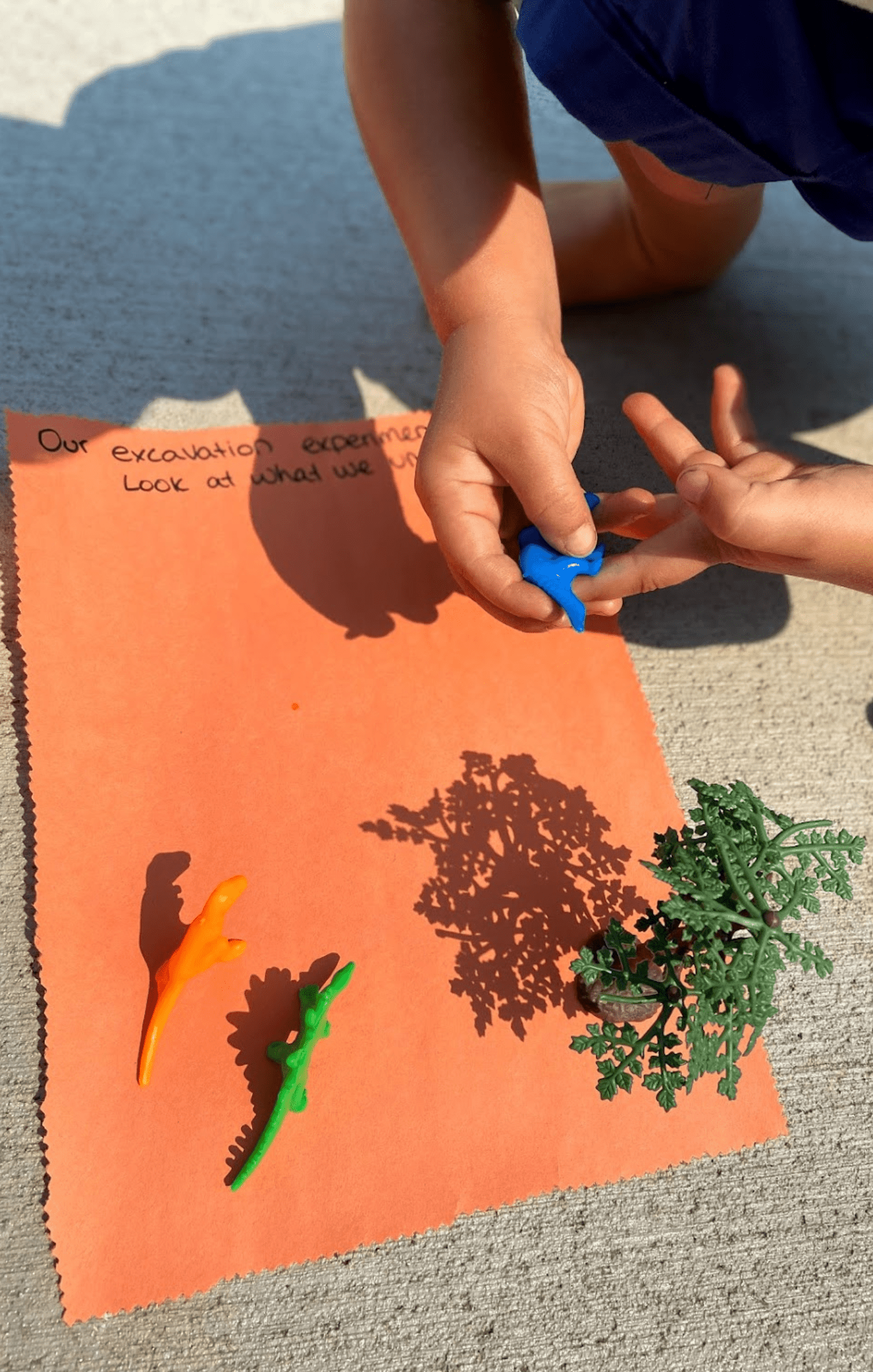
Place your paper on the flat surface and arrange objects around it so their shadows fall onto the page. Toys, small sculptures, and household objects all work. The shadow from a building block creates a very different shape than the shadow from a stuffed animal or a potted plant.
You can also skip the objects entirely and use hands or bodies instead. Hand shadows are a classic for a reason. For a full-body tracing, you will need a second person to do the drawing while the child holds a pose.
Trace and get creative
Once the shadow falls where you want it, trace the outline with a pencil or chalk. After the outline is down, the real creative work begins. Kids can color in the shape, add patterns, draw backgrounds, or turn the shadow into something completely different.
This is also a great moment to bring in other materials. A child can build a shape out of Play-Doh or LEGO, cast its shadow onto the paper, and then trace it. That small extra step turns the activity into a craft and an art project at once.
Bring in nature
The natural world offers some of the most interesting shadow shapes. A leafy branch, a large flower, or a garden stake all cast complex, organic outlines that are satisfying to trace and color. Try placing the paper under a tree to capture the pattern of light filtering through the leaves. The results look different every time, depending on the breeze and the angle of the sun.
Activities like this pair well with other science activities for preschoolers that use the outdoors as the classroom. Kids are naturally curious about how light and shadow work, and giving them a way to document what they observe makes the learning stick.
Questions to prompt deeper thinking
Once the basic tracing is done, you can push the activity further with a few simple questions. Ask your child what happens if they trace the same object at a different time of day. The shadow will have shifted, and comparing the two drawings side by side makes that change visible and concrete.
Ask what happens when they move the object to a different spot on the page. Can they make the shadow longer or shorter? What changes when the object is tilted? Can they find an angle where the shadow almost disappears?
You can also ask whether this activity could work indoors. A lamp or a flashlight near a window can cast shadows just like the sun does. Trying it both ways gives kids a chance to compare a fixed light source with one that moves across the sky over the course of a day.
These kinds of open questions connect shadow drawing to cognitive development. Kids practice observation, prediction, and comparison without it feeling like a lesson.
Tips for different ages
Toddlers do best with simple, large objects and lots of room to scribble freely. The goal at this age is exploration, not precision. Let them respond to the shadows in their own way.
Preschoolers can manage basic tracing with some help holding the object steady. Chunky sidewalk chalk is easier for small hands than a standard pencil. Keep the session short and let them lead.
School-age kids can take on more complex versions of the activity. They can build their own objects to trace, compare shadows at different times of day, or work on more detailed coloring and design after the tracing is done. This age group also tends to enjoy the experimental side, testing different objects, angles, and positions to see what changes.
If you are looking for more activities for kids that work across a range of ages, shadow drawing is a reliable choice. It scales up and down easily, and it works on any sunny day without requiring a trip to the store.
Displaying the finished artwork
Shadow drawings make genuinely interesting wall art. The traced outlines, filled in with color and pattern, often look more striking than a standard coloring page because the shapes are unusual and personal. Each drawing reflects what was in the yard that day, what the child chose to trace, and how they decided to fill it in.
Sidewalk chalk drawings are temporary by nature, but you can photograph them before they wash away. A photo of a full-driveway shadow mural is worth saving.
Paper drawings can go straight onto the wall or into a binder. If your child traced the same object at different times of day, displaying those drawings together tells a small visual story about how light moves. That kind of display turns the artwork into something that keeps teaching long after the activity is done.
Shadow drawing is one of those activities that earns its place in regular rotation. It is free, flexible, and genuinely interesting for kids. Give it a try on the next sunny morning, and see what your child notices.




Leave a Reply