
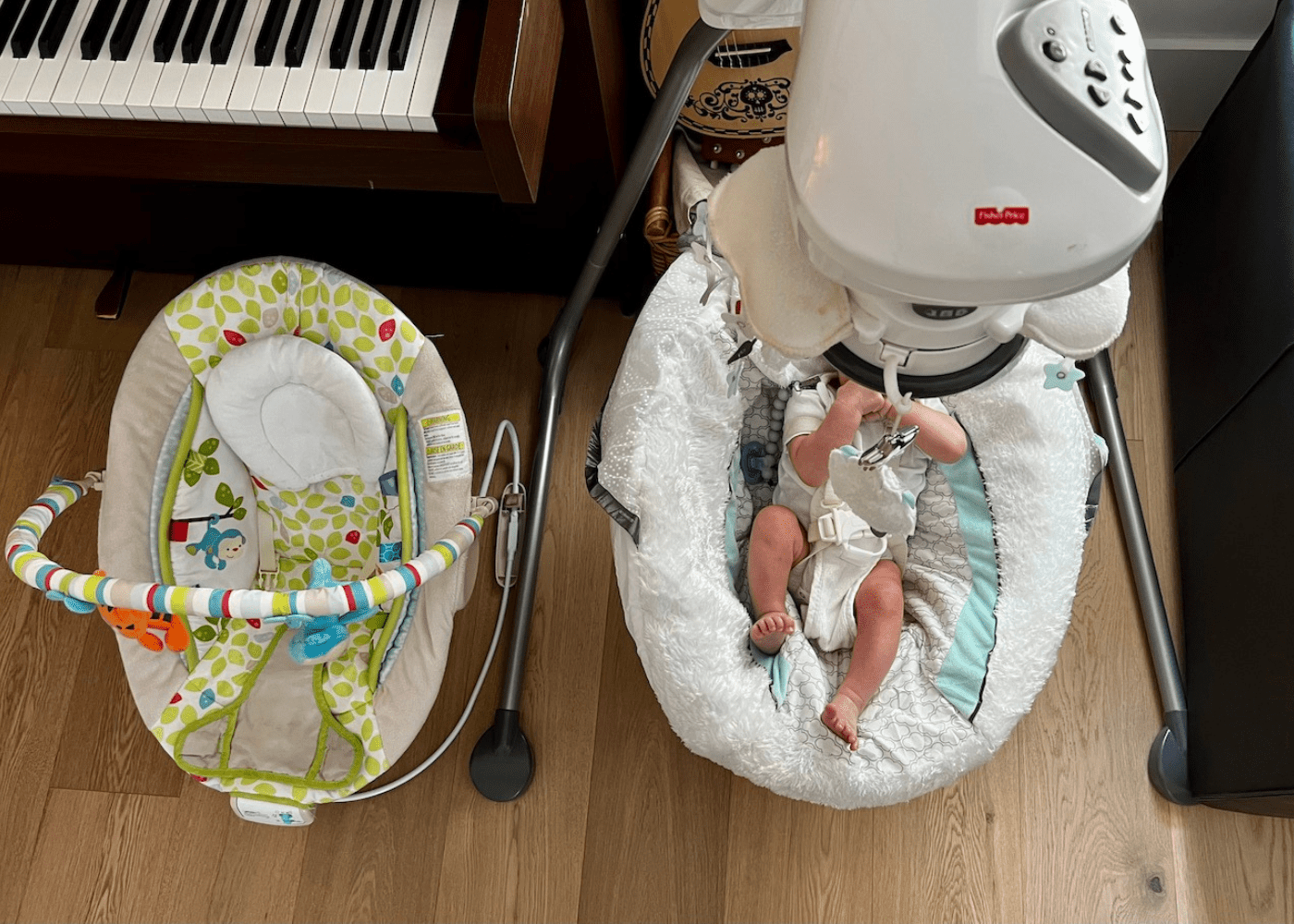
When you’re setting up for a new baby, the list of gear feels endless. Two items that often cause confusion are the baby bouncer and the baby swing. They look similar, they serve some of the same purposes, and both tend to sit in the living room for the first several months. But they work differently, and the right choice really does depend on your baby, your space, and your daily routine.
This post walks through both options clearly so you can make a practical decision. There is no universally correct answer, but by the end you should have a good sense of which one fits your situation.
What each one actually does
A baby bouncer is a lightweight, reclined seat that sits low to the ground. It moves when the baby moves, or when a parent gives it a gentle push. The motion comes from the baby’s own weight shifting, or from you rocking it with your hand or foot. Bouncers are simple by design. They are easy to fold up, carry from room to room, and store when not in use.
A baby swing is a motorized seat that moves on its own. Most swings run on batteries or plug into an outlet. They typically offer several swing directions, including side to side and front to back, along with multiple speed settings. Many models include white noise, music, or vibration features. Swings are larger and heavier than bouncers, and most are meant to stay in one spot.
Both seat your baby in a reclined position. Both provide rhythmic motion. The key differences come down to size, portability, power source, and cost.
What to think about before you buy
Your baby’s temperament
Some babies settle quickly with very gentle motion. For those babies, a bouncer is often enough. Other babies need sustained, consistent movement to calm down or fall asleep. A swing can offer that without requiring you to keep pushing or rocking manually. If you have a particularly fussy baby who seems to want constant motion, a motorized swing may save your sanity in those early weeks.
The honest truth is that you often won’t know your baby’s preferences until they arrive. If budget is a concern, starting with a bouncer and adding a swing later is a reasonable approach.
How much space you have
Bouncers are compact. Most fold flat or collapse into a small footprint, which makes them practical for smaller homes or apartments. You can tuck one under a crib or behind a couch when it’s not in use.
Swings take up considerably more floor space. The frame is wide and sturdy, and it typically needs to stay in one place. Before buying a swing, measure the area where you plan to use it. Some parents are surprised by how large these are in person.
If you are short on space but still want something with a bit more motion than a basic bouncer, look into portable swings. They are more compact than full-size models and some fold down for easier storage. They do tend to have fewer features, but for many families they strike a good balance.
Your budget
Bouncers are generally less expensive than swings. A basic bouncer can cost under $50, while a well-reviewed swing often runs $100 to $200 or more. That said, both categories have budget options and premium models, so there is range on either end.
If cost is a factor, buying secondhand is worth considering. Local buy-and-sell groups and community parent groups often have lightly used bouncers and swings available at a fraction of the retail price. Just make sure any secondhand item has not been recalled, is structurally sound, and includes its original harness hardware.
Portability
If you visit family often or want to bring baby gear to other people’s homes, a bouncer wins on portability. Most are light enough to carry in one hand, and some fold into a bag. A full-size swing stays home. If you travel frequently or simply want something that moves room to room with you, factor that into your decision.
Safety basics for both
Whether you choose a bouncer or a swing, the safety guidelines are consistent and worth taking seriously.
Always use the harness. Every time. Even if your baby seems content and you are just stepping into the next room. Always place the bouncer or swing on a flat, stable surface, and never on an elevated surface like a table or countertop. Never leave a baby unattended in either device.
Do not add pillows, blankets, or positioners to the seat. The seat is designed to support your baby as-is. Extra padding or soft items can obstruct the airway.
Check the weight limit before each stage of use. Most bouncers and swings have a maximum weight printed clearly in the manual. When your baby reaches that limit, or when they start pulling up or pushing out of the harness, it is time to retire the item. Your baby’s pediatrician can also give guidance on when it is appropriate to stop using these devices.
Inspect the product before each use. Look for cracks, fraying straps, or loose parts. If anything looks worn or damaged, stop using it until you can confirm it is safe.
Positioning and age considerations
Newborns must be in a fully reclined position. They do not yet have the neck strength to hold their heads up, and an improper angle can cause the head to fall forward and obstruct the airway. Most bouncers and swings designed for newborns include a reclined or near-flat seat position for this reason.
As babies grow and develop head and neck control, usually around four to six months, some swings and bouncers offer a more upright setting. Some models include an adjustable seat that can grow with your baby from newborn through infant stages.
Always check the age and weight guidelines listed by the manufacturer for the specific model you own. When in doubt, ask your pediatrician. They can look at your baby’s development and help you decide what position and product makes sense at each stage.
What about baby rockers?
Baby rockers are worth a brief mention because they come up often in this conversation. A rocker sits somewhere between a bouncer and a swing. It provides a gentle rocking motion, sometimes manually and sometimes motorized, but tends to have a slightly different seat design. Some rockers are built to convert into a toddler seat as the baby grows, which can extend the value of the purchase.
You can apply the same criteria above when evaluating a rocker: look at the size, the weight limit, the motion type, and the safety features. They are a legitimate third option if neither a pure bouncer nor a full swing feels right for your setup.
So which one should you choose?
If you have limited space, a tighter budget, or want something you can move around the house easily, start with a bouncer. It is the lower-commitment option and works well for many babies in those early months.
If you have a very fussy baby, want hands-free soothing without manual effort, and have space for a larger item, a swing is worth the investment. The motorized motion can be a real help during those early weeks when your baby needs a lot of settling.
Some parents end up with both, especially if they have a bouncer from the newborn stage and later add a swing when they realize their baby wants more consistent motion. That is a completely valid path, and buying a secondhand bouncer first keeps the cost manageable.
Whatever you choose, the priority is that your baby is safely secured, supervised, and within the age and weight guidelines for the product. The best bouncer or swing is the one that actually fits your home and your baby’s needs right now. For more ideas on toddler care and setting up your home for little ones, the nursery organization and child care sections of this site have a lot of practical resources worth browsing.




Leave a Reply