
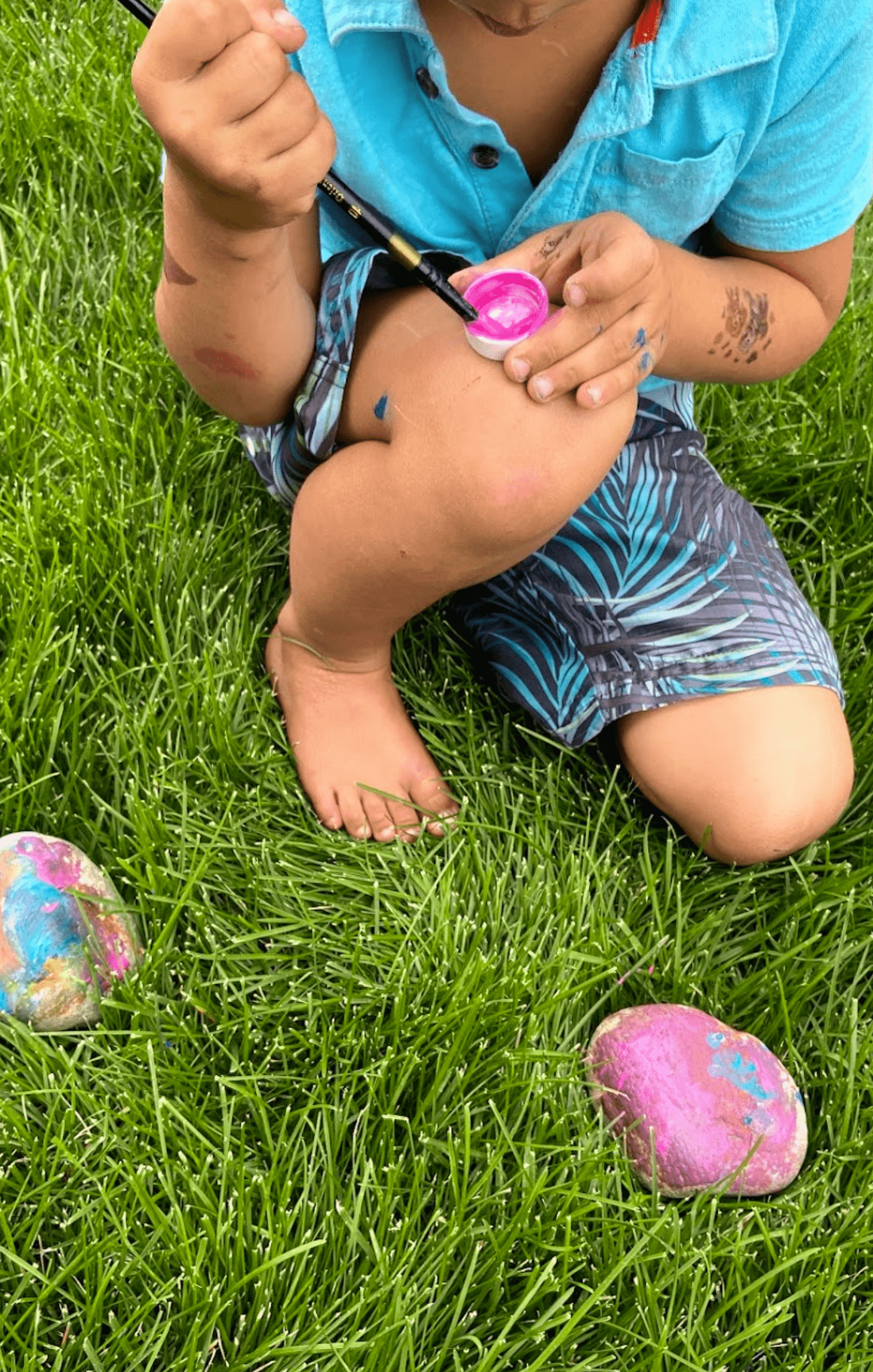
Toddlers don’t need much to have a great afternoon. What they do need is something to do with their hands, their bodies, and their curiosity. This list of 20 activities covers all of that without requiring special supplies or a lot of prep time. Whether you’re stuck inside on a rainy day or just trying to get through the afternoon without turning on the TV, these ideas are practical and easy to pull together.
I keep many of these in my back pocket for exactly those moments when a child needs a reset and I need a few minutes to think. Most use things you already have at home.
20 quick and easy activities for toddlers
1. Hide and seek
Hide and seek is one of the best indoor games for this age group. It’s a natural extension of peek-a-boo. One person hides while the other looks. For toddlers, this game quietly teaches object permanence, which is the understanding that something still exists even when you can’t see it. They get genuinely excited when they find you, and that reaction never gets old.
2. Dramatic play
Set up a pretend grocery store using items from your pantry, or use toy food if you have it. Give your child a small basket and ask them to pick a set number of items to “buy.” Keep the number under ten so things don’t get out of hand, and you’ll sneak in some counting practice at the same time. A tea party works just as well. Make a simple snack together, pack a small basket, and head outside or set up a little spread at a low table.
Dramatic play builds cognitive awareness and helps children understand the purpose of everyday objects. It’s one of the most valuable things a toddler can do with their time.
3. Make wrapping paper
If you have a roll of butcher paper or plain brown paper, tape a large piece to the floor or table and let your child draw freely on it. The finished result makes genuinely nice gift wrap or can be cut into smaller pieces and framed. For something more structured, try fingerprint art. Red Ted Art has some great inspiration for this if you want a starting point.
4. Water sensory bin
Fill a plastic tub with water and add a few drops of food coloring, some dish soap for bubbles, and small containers for scooping and pouring. Connecting tubes are a great addition for some basic STEAM building. Do this outside if you can, and keep a towel nearby. An apron helps too. Toddlers will play with water for a surprisingly long time when you give them the right tools.
5. Themed sensory bins
A sensory bin doesn’t need much to keep a toddler busy. Pick a theme, like a construction site, a garden, or the alphabet, and fill a container with a base material and a few props. Good base options include dried rice, dried beans, flour, cereal, shredded paper, pom poms, or even dirt and snow for outdoor bins. Add small scoops, tweezers, and containers to encourage fine motor work. Always supervise young children in sensory bins, since toddlers will often taste what they find, which is why edible bases are a smart choice for this age.
6. Mixing colors
Set out a tray, a brush, and watercolor paints in red, yellow, and blue. Ask your child to mix colors on the tray and paint what they create on paper. This is an easy way to introduce color theory, and it requires almost no setup. It’s one of the messier options on this list, but the payoff is worth it.
7. Playdough monsters
Put out playdough, googly eyes, popsicle sticks, and pipe cleaners and let your child build whatever they want. This is a completely open-ended activity with no wrong answers. I also like to offer a large bubble letter printed on paper inside a plastic sleeve so they can press playdough into the shape and reuse the template again and again. Animals, shapes, and numbers all work the same way.
8. Make playdough together
Making playdough from scratch is one of those activities that doubles as both the process and the product. All you need is flour, salt, water, and food coloring. It costs almost nothing compared to store-bought versions, and toddlers love being involved in making something they’ll use later. The BBC Good Food recipe is a reliable one to bookmark.
9. Color and shape sorting
Gather toys or craft materials from around the house and ask your child to sort them by color. Set out baskets or colored mats as visual guides. Once they’ve sorted by color, ask if they can find another way to group the same objects, by size, by weight, or by use. Sorting is a foundational math concept that children will keep building on through preschool and kindergarten.
10. Finger painting and alternative painting
Finger painting builds sensory awareness while giving children a low-pressure way to make art. If your child doesn’t enjoy the texture, offer alternatives like sponges, cotton balls, Q-tips, feathers, leaves, or bottle caps. You can also make an edible finger paint by mixing flour, water, and food coloring. Make only what you need for the day and dispose of it afterward, since it won’t keep safely.
11. Dance parties and music
Put on music and move. It really is that simple. Toddlers respond to music naturally, and dancing builds gross motor skills without feeling like exercise. Try different genres to see what your child connects with. Nursery rhymes and simple songs are great for language development too. YouTube has plenty of guided dance-along videos if you want some structure.
If you want to take it further, let your child explore a simple instrument. Even a small drum or a set of shakers is enough to keep a toddler happily occupied.
12. Building and stacking
Blocks, plastic cups, cardboard tubes, and small boxes are all you need for this one. Give your child a building challenge. Ask them to build something tall, something that holds a toy car, or something that can survive a gentle nudge. This kind of play builds spatial reasoning and early engineering thinking. It also tends to end with the satisfying crash of knocking everything down, which toddlers find endlessly entertaining.
13. Nature walk with the five senses
A walk is a good idea on its own, but adding a sensory focus keeps toddlers engaged longer. Ask them to find five things they can hear, five things they can smell, and five things they can touch safely. Bring a simple worksheet to record what you find. Our 5 senses nature walk worksheet is a free download you can print and bring along. Stick to touching and listening and smelling unless you are completely certain that what they want to taste is safe.
14. Simple crafts
Crafts are well-suited to toddlers because cutting, tearing, gluing, and folding all build fine motor skills while giving children something creative to show for their effort. I find it helps to offer two or three options rather than an open-ended “what do you want to make?” question, since too many choices can lead to frustration. Pinterest is a good source of inspiration, and so is our collection of easy crafts for kids.
15. Cook or bake together
Cooking introduces math and language in a very natural way. Measuring, counting, and following steps all happen without it feeling like a lesson. Simple recipes work best for this age. Mexican-inspired foods are a fun option, and no-bake recipes like ants on a log require almost no supervision once you have the ingredients ready. Muffins are another reliable choice since the steps are simple and the result is something they’re proud to eat.
16. Reading together
Reading with your child is one of the simplest and highest-impact activities you can offer. After finishing a book, try asking your child to draw a picture from the story, act out a scene, or make up what happens next. These extensions build comprehension and imagination at the same time. If your child is interested, they can also create their own simple book with a few pages. You write down their words and they illustrate.
17. Cardboard box creations
A cardboard box can become almost anything. A delivery van, a spaceship, a sled, a boat. All it takes is basic art supplies and some imagination. Add cardboard tubes, paper plates, and paper scraps to expand the options. This activity is wonderful for fine motor development since cutting, gluing, and assembling all require hand control. Make sure an adult handles any sharp cutting, and then hand the project over to them as much as possible.
18. Science experiments
Toddlers are natural scientists. They love to observe, predict, and test. Simple experiments using baking soda and vinegar, oil and water, or milk and food coloring are all doable with household supplies. Most of what you don’t have at home can be found inexpensively at a dollar store. For a large collection of ideas, our post on 50 simple science experiments for kids is a good place to start.
19. Feed the monster game
This one takes a few minutes to set up but pays off well. Decorate a small box with paper, paint, and googly eyes to create a monster with a wide open mouth. Then decide what the monster “eats.” It could be a certain letter, a shape, a color, or even items to sort for recycling. Toddlers love feeding the monster, and it’s a surprisingly effective way to practice recognition and sorting without it feeling like a lesson. It also works well as a cleanup game if something has been scattered across the floor.
20. Obstacle course
When a toddler has a lot of energy to burn, an obstacle course is one of the most effective options available. Outside, use chairs, pool noodles, and low items to jump over. Add a finishing challenge like knocking down a stack of cups or tossing a ball into a laundry basket. Inside, tape a path on the floor with painter’s tape, hang a string low for limbo, or set up a tunnel to crawl through. They’ll work on balance, coordination, and gross motor skills while having a good time.
What makes a good activity for toddlers?
The best activities for this age involve the hands, the body, or both. Toddlers learn through doing. They need movement, sensory input, and the chance to make decisions, even small ones. Activities that are slightly challenging but still within reach tend to hold attention the longest. Too easy and they lose interest. Too hard and they get frustrated.
It also helps to rotate activities rather than offering the same ones every day. Many of the ideas above can be done repeatedly with small variations to keep them feeling fresh. A sensory bin with rice one week and dried beans the next is a different experience even though the setup is the same.
Frequently asked questions
What activities are good for toddlers?
Activities that involve movement, creativity, and sensory exploration are well-suited to toddlers. Simple options like building, painting, dancing, and outdoor walks give children a chance to develop motor skills and express themselves. The goal is engagement, not perfection. An activity doesn’t need to produce a finished product to be worthwhile.
What should a 2-year-old be doing for activities?
Two-year-olds do well with sensory activities, simple art projects, dramatic play, and building with blocks or soft materials. Puzzles with large pieces, simple sorting games, and water play are also good fits. Keep activities short and expect to switch gears more often than you might with an older child.
How do I keep my toddler busy throughout the day?
Variety helps more than quantity. Rotate between active play and quieter activities throughout the day. Pair something physical, like an obstacle course or a dance party, with something calm, like reading or playdough. Having a few reliable go-to activities ready makes the day feel more manageable for both of you. The 20 ideas above are a good starting point, and most can be repeated with small changes to keep things interesting.
For more ideas, take a look at our rainy day activities for toddlers, our list of summer activities for toddlers, and our full collection of kids activities.




Leave a Reply