
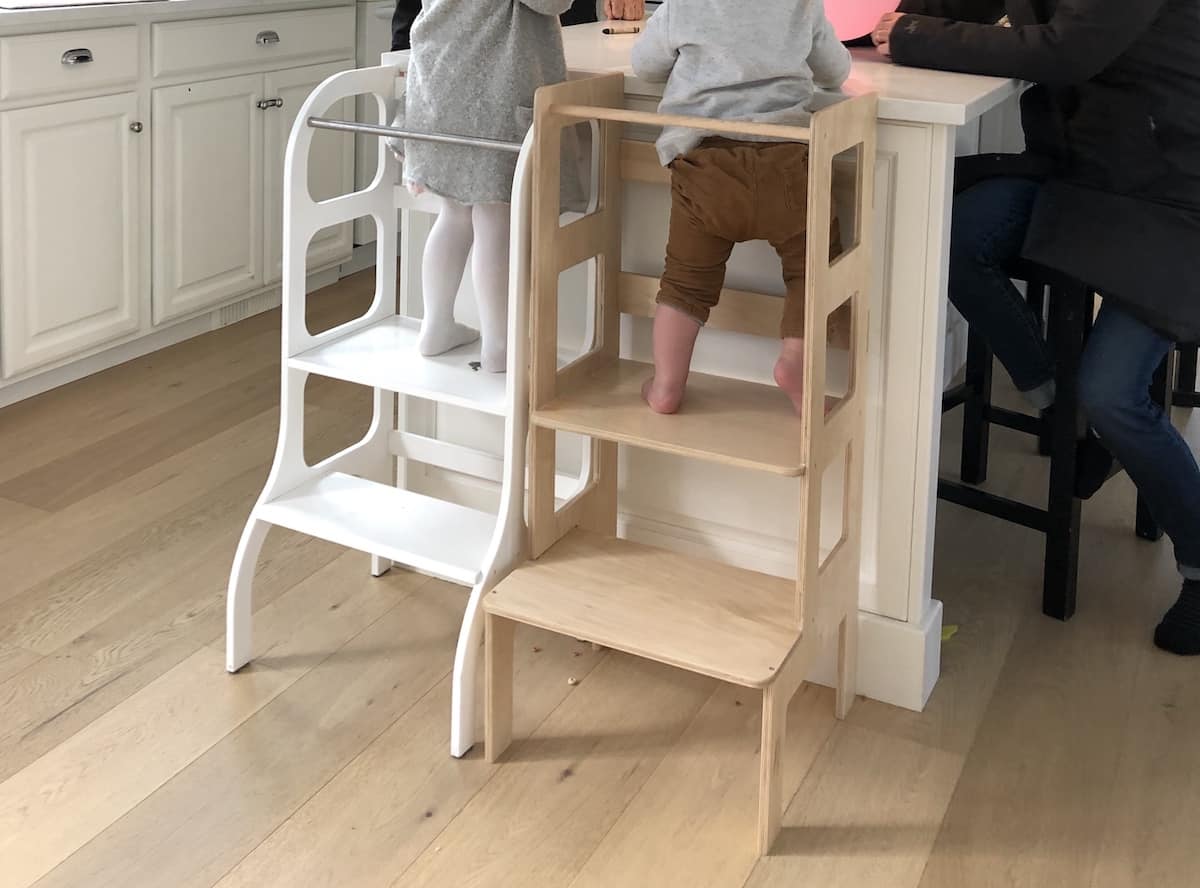
A learning tower might be one of the most useful pieces of furniture you can add to your home with a toddler. It solves a real problem that most families face every day: your child wants to be part of what you’re doing, but the kitchen was designed for adults. Counters are too high. The action is out of reach. And being picked up every few minutes is exhausting for everyone.
I first brought up learning towers in the context of Montessori kitchens, but they deserve a closer look on their own. Whether or not you follow a Montessori approach at home, a learning tower can genuinely change how your child experiences daily life in the kitchen and beyond.
What is a learning tower?
A learning tower is a wooden platform structure that brings a child up to counter height. It has a few built-in steps, three solid sides, and a bar at the back. The design keeps a child secure while giving them a wide, stable surface to stand on. You may also hear it called a kitchen helper or a toddler tower.
The original learning tower concept was developed by a Montessori educator who was also a mom. She wanted to give young children the ability to participate in kitchen activities without constantly needing adult help. The Little Partners Learning Tower was the first widely known version of this design, and it set the standard for what most learning towers look like today. Many current models are inspired by that original, with adjustable height platforms, Greenguard Gold certifications, and optional add-on accessories.
At its core, though, the idea is simple. Your child stands on a stable platform at the right height to see, reach, and participate. That changes everything about how they experience the kitchen.
What age is a learning tower for?
Most manufacturers list 18 months as the minimum age, which is a reasonable starting point. If your child can climb stairs safely, they can likely use a learning tower with supervision. The toddler years are when these towers get the most use, because toddlers are naturally curious and physically capable of getting involved in simple kitchen tasks.
That said, many kids continue using them well into the preschool years. Around age four or five, some children start to feel a bit confined in the more enclosed toddler-style designs. If that happens, you may want to look at a more open platform style, or one with a higher weight limit and a less contained structure.
As long as the tower’s weight limit fits your child, there’s no hard cutoff for when they have to stop using it. Some families get years of use out of a single tower, especially models with adjustable platform heights.
What can kids do in a learning tower?
The most obvious use is helping in the kitchen. Kids can stand at the counter while you cook, hand you ingredients, stir batter, wash fruit, or just watch how a meal comes together. That kind of observation is genuinely valuable. Children learn a lot simply by being present and involved.
Water play is another big one. Most toddlers love “washing” dishes or rinsing vegetables. In practice, this usually looks like filling cups and pouring them out repeatedly while bubbles get everywhere. That’s fine. It builds motor skills and sensory awareness, and it keeps them meaningfully occupied. You might need to wipe down the counter afterward, but it’s worth it.
Learning towers work well outside the kitchen too. A child can stand at a craft table, a bathroom sink, or anywhere else where the counter height is too tall. If you’re working on science activities for preschoolers at the kitchen counter or doing art projects at a table, a learning tower can bring your child right into the process.
Some families use them as a standing eating spot, which younger toddlers often prefer to sitting. Others use them during baking sessions as a way to work on early math concepts like measuring and counting ingredients.
The real benefits of using one
The independence piece is the biggest benefit. A child who can get into their tower, stand at the counter, and participate without being lifted or carried feels capable. That feeling matters. It builds confidence over time, and it reduces the constant need for adult intervention during everyday tasks.
It also keeps kids close and engaged during times that are otherwise hard to manage. Cooking dinner while a toddler circles your feet is stressful. Having them up at the counter with a safe task to work on changes the dynamic completely.
From a Montessori home perspective, the learning tower supports a child’s natural drive to do real work alongside adults. It’s not a toy version of an activity. It’s the actual activity, adapted to their size and ability.
What to know before you buy
Cost
Learning towers are not cheap. Most quality wooden models run between $150 and $350, and some specialty designs cost more. That price reflects solid construction, weight capacity, and in many cases adjustable heights that let the tower grow with your child.
There are more affordable options. Some basic models come in around $145 to $190, and some of those are made in North America. If your budget is tight, it’s also worth looking into DIY plans. There are downloadable building plans available online for around $12 that let a handy family member build one from scratch. The result can be just as functional and just as loved as a store-bought version.
Size and storage
A learning tower takes up floor space. It’s not something you can easily slide into a cabinet or tuck behind a door. In a small kitchen, that matters. Before buying, measure your available floor space and think about where the tower will live day to day.
Some models are designed with storage in mind. Foldable designs and towers with a smaller footprint exist if space is genuinely limited. It’s worth looking for those features specifically if your kitchen is on the smaller side. You can also check out small kitchen storage ideas for ways to make the overall layout work better when you’re adding something new to the space.
Safety
Learning towers are safe when used correctly, and that means teaching your child how to use one from the start. Go over the basics clearly. Explain that they need to keep their feet on the platform, not rock the tower, and not try to climb onto the counter. These are simple rules, but they need to be stated directly and reinforced consistently.
The temptation to reach further is real. Kids get excited at counter height because there’s so much to see and touch. If yours keeps trying to climb over the front, try adjusting the platform to a different height so they feel less like they need to stretch. Moving items closer to them on the counter also helps.
A non-slip mat under the tower adds an extra layer of stability on tile or hardwood floors. Make sure it fits the base of your specific model so it doesn’t create a tipping risk.
Is a learning tower worth it?
For most families, yes. The combination of independence, engagement, and safety makes it one of the more practical investments you can make for a toddler. It solves a real daily challenge and holds up well over multiple years of use.
The main reasons it might not work for your family are cost and space. If your kitchen is very small and you have no good place to put it, it will become an obstacle rather than a help. And if the price is a barrier, the DIY route is a legitimate option worth considering.
Outside of those two factors, learning towers are genuinely useful. Kids love them, they last a long time, and they make everyday tasks more manageable for everyone. If you’re thinking about ways to build more independence into your child’s daily routine, this is one of the more effective tools available.




Leave a Reply