Math doesn’t have to happen at a table. The outdoors is full of numbers, shapes, patterns, and data just waiting to be noticed. Taking math outside gives children a chance to learn through touch, movement, and real observation. That kind of hands-on experience tends to stick better than a worksheet alone. If you’re curious about what preschool math concepts children work on in their early years, that post is a good place to start.
This post covers practical ideas for finding math in nature with preschool-aged children. You’ll find activities for counting, geometry, measurement, sorting, and patterns. Most of these require nothing more than a walk outside and a curious child.
Numbers and counting in nature
In the preschool years, children work on numbers one through ten. They learn to count objects, recognize written numbers, put numbers in order, and begin to recognize small groups without counting each item one by one. Nature gives you endless material to practice all of this.
Counting with chalk circles
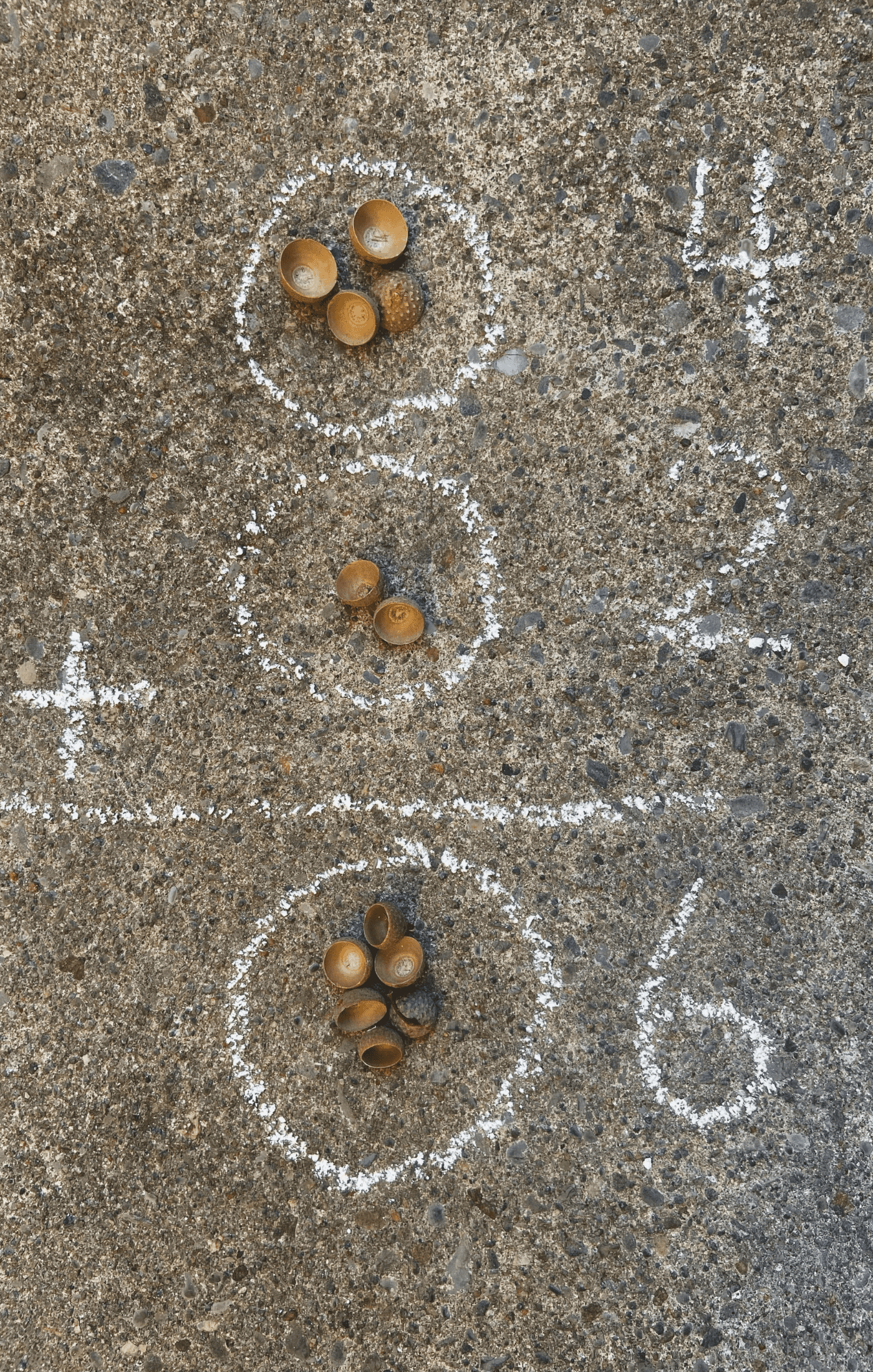
Grab some sidewalk chalk and draw ten circles on the pavement. Write one number in each circle, from one to ten. Ask your child to read the numbers, then send them off to gather natural objects to fill each circle. Start together if it helps. Pick up two leaves, count them out loud, and ask which circle they belong in. Once your child gets the idea, let them work through the rest on their own.
For a more lasting version of this activity, paint numbers onto rocks and use those as permanent markers. It adds a small art project to the mix and gives you something to reuse.
Counting tree rings
One of the most satisfying things to show a child is that you can read a tree’s age from its rings. Each dark ring represents one year of growth. If you find a stump or a cut log nearby, this is easy to do in real life. Natural wood rounds from a craft store also work well.
Count the rings together and compare a few samples if you can find them. It’s interesting to see how the size of the trunk reflects age, and children often get genuinely invested in finding the oldest one. This activity also opens up a simple conversation about forests and how long trees take to grow.
Counting anything
Outside, there is always something to count. Petals on a flower, bees on a plant, birds on a wire, pinecones under a tree. Ask your child what they want to count. They’ll be more engaged when they choose the subject themselves.
Ordering and sequencing
Sequencing asks children to put things in a specific order. Collect sticks, rocks, or leaves in different sizes and arrange them from smallest to largest. You can also collect small groups of items and line them up from least to greatest. One stick, two leaves, three rocks. Then ask what would come next.
Subitizing outdoors
Subitizing is the ability to recognize a small number of objects at a glance, without counting each one. When you see three apples on a counter, you don’t count them one by one. You just know it’s three. This skill matters because it builds number sense and makes later math faster and more intuitive.
Start with one. Ask your child to find a single object in nature. A rock, a tree, a bird. Then move to groups of two, and so on. Once they’re comfortable with several numbers, find a larger group of objects and ask them to count. When they finish, ask how they counted. Did they group by twos? By fives? Try it a different way and see what changes.
Addition and subtraction in nature
Keep the numbers simple at this stage. Children are working within one to ten, so the equations should reflect that. The most effective approach is to start with concrete, physical examples before moving toward abstract thinking.
Make small piles of objects on the ground to represent a math equation. Two rocks plus one rock equals three rocks. Circle each group with chalk and write the equation nearby. Ask your child to solve it by counting the objects. This lets them connect the written symbols to something they can touch and move.
Painted number rocks work well here too. They’re reusable and bring a bit of creativity into the activity. Once your child has a solid grasp of equations with physical objects, move toward more abstract questions. Point to a cluster of trees and ask how many there are. Then ask how many there would be if one more grew. That mental leap is significant, and building up to it gradually makes a real difference.
Geometry in nature
Shapes appear everywhere outdoors, and preschoolers are working on two-dimensional shapes like circles, triangles, squares, and rectangles. Finding them in the real world helps children understand that geometry isn’t just something on a page.
Shape activities outside
One simple activity is shape matching. Make small cards with one shape drawn on each, and ask your child to find that shape somewhere in nature. A circular stone, a triangular leaf tip, a rectangular window on a nearby building. See how many examples they can find for each shape.
Pick something complex, like a leaf or a tangle of branches, and look for multiple shapes within it. Triangles, ovals, and curves can all appear in a single object. Looking up at clouds is another easy way to find and name shapes.
Children can also create shapes directly in the earth using a finger or a stick. Drawing in sand or soft dirt is satisfying for this age group and requires no materials at all. Collecting natural objects and arranging them into shapes on the ground is another option that works well as a group activity.
Spatial reasoning outside
Spatial reasoning involves understanding where things are in relation to each other. It includes the language we use to describe position, like on top of, beside, underneath, and between. Building activities are one of the best ways to practice this outdoors.
Stacking rocks, building with sticks, or shaping sand all give children hands-on practice with spatial relationships. While you build together, use positional language naturally. Put the flat rock on top of the round one. Place the stick beside the pile. That language becomes part of how children think about space.
Making a simple map of a familiar outdoor space is another good activity. Where do the birds tend to gather? Where does the big tree stand? This kind of spatial memory and representation is an early form of mathematical thinking.
Measurement and graphing outdoors
Measurement becomes much more interesting when children can apply it to real objects. Bring a ruler outside and let your child measure whatever catches their attention. Sticks, leaves, puddles, shadows. It doesn’t need to be structured. The act of measuring and comparing builds the concept naturally.
Practice measurement language as you go. Which stick is longer? Can you find two rocks that are about the same size? Which leaf is the widest? These questions build vocabulary alongside the math skill.
Collecting data outside is also worth trying. On a fall walk, count how many red, orange, yellow, and green leaves you can find and record the totals. On a farm or in a garden, count how many of each type of plant or animal you spot. Preschoolers can use stickers or color in boxes to track their findings, which makes the graphing feel more like art than homework. A simple nature counting activity like this works well for this age group.
Sorting and patterns in nature
Sorting is one of the most accessible math activities for young children outdoors. It doesn’t require any materials beyond what you find on the ground. Ask your child to collect objects and group them by color, size, shape, or texture. There’s no single right answer, which makes it a low-pressure way to practice organizing and categorizing.
Patterns appear everywhere in nature once you start looking. A gardener who planted red, yellow, red, yellow flowers created a pattern. The spiral on a shell follows a pattern. The way seeds sit in a sunflower head follows a pattern. Start with simple, obvious patterns and ask your child to identify what repeats.
The Fibonacci sequence
Once you get comfortable spotting patterns, it’s worth learning about the Fibonacci sequence. This is a naturally occurring number pattern found throughout the natural world. The sequence goes: 0, 1, 1, 2, 3, 5, 8, 13, 21, 34, and so on. Each number is the sum of the two before it.
This pattern shows up in the spiral of a nautilus shell, the way a rose unfolds, the curl at the tip of a fern leaf, and the seed arrangement on the bottom of a pinecone. It’s a complex concept for a preschooler to grasp fully, but introducing it in simple terms, “look at how this pinecone swirls,” plants a real seed of mathematical curiosity.
You don’t need to teach the numbers themselves. Just pointing out the spiral and saying that mathematicians found a pattern in it is enough to start. Children at this age are often more ready to notice patterns than we expect, especially when the examples are right in front of them. For more ideas on weaving math into the natural world, there’s plenty to build on as children grow.
Putting it all together
The goal of taking math outside is not to replace classroom learning. It’s to make abstract concepts feel real. When a child counts the rings on a stump, measures a stick, or spots a spiral on a pinecone, math becomes something that exists in the world, not just on paper.
These activities work well as part of a regular outdoor routine. You don’t need to plan a formal lesson. A walk with a few intentional questions is enough. Over time, children begin to notice math on their own, which is exactly the point.
If you want to keep the learning going at home, there are free printables and activity ideas over at the free printables page. For more structured early math practice, the posts on kindergarten math concepts and kindergarten math word problems are helpful next steps. You can also find free number tracing worksheets and tally mark worksheets to round out what you’re working on.