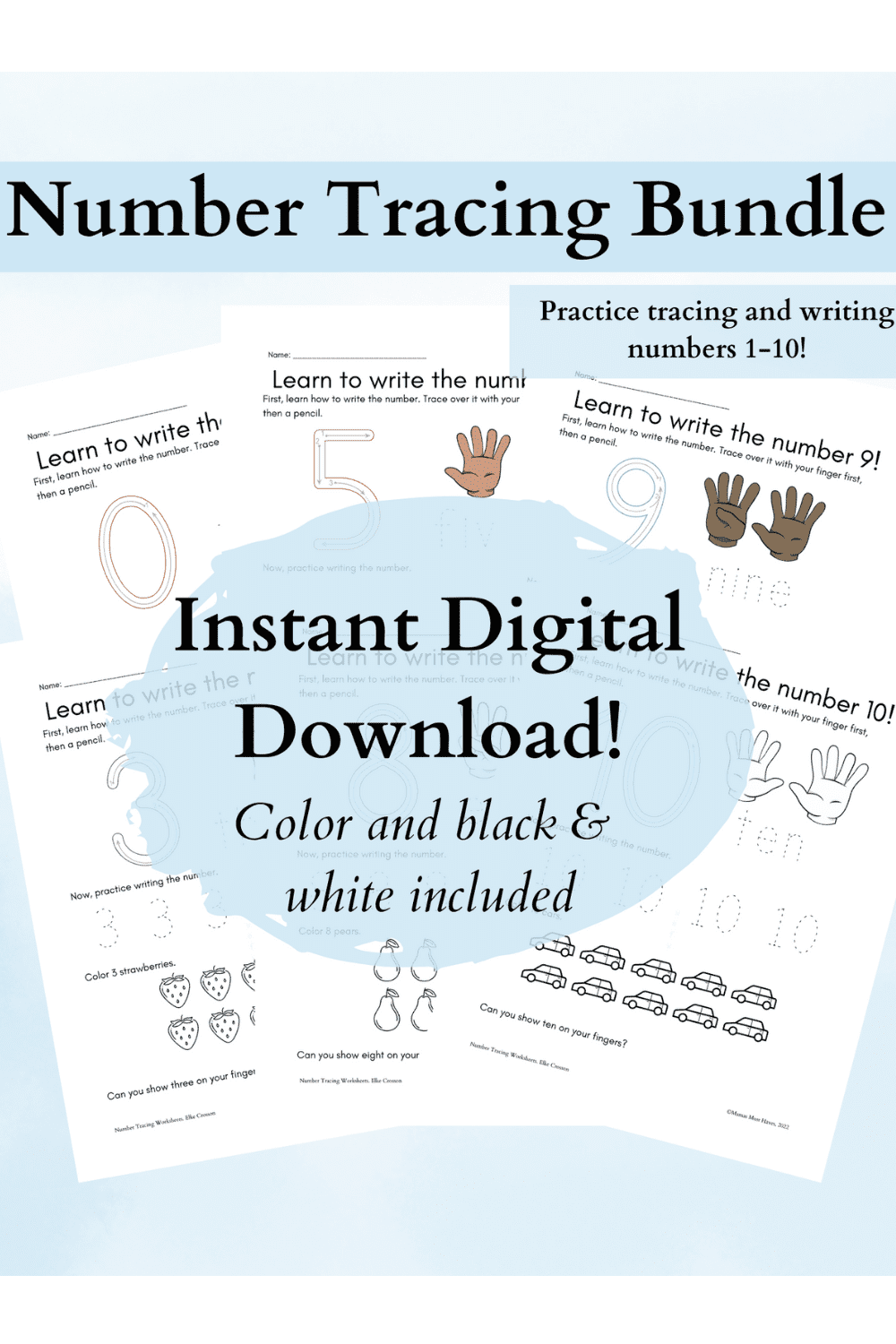
Number tracing worksheets give young children a simple, hands-on way to practice writing numbers, recognizing them, and counting. These free printable pages work well for preschool and kindergarten-aged kids, and they cover a lot of ground in one sitting. On each page, children practice writing the number and its name, count a set of matching objects, and show the number on their fingers. They can also color the images when they’re done, which keeps them engaged a little longer.
If you want to get the most out of these pages, it helps to pair them with a few other activities. Read on for ideas on building fine motor skills and number recognition alongside the worksheets.
How to get the free number tracing worksheets
These worksheets are free to download. You can either click the PDF link in this post or visit Crosson’s Classroom on Teachers Pay Teachers to grab the full bundle. Just download, print, and you’re ready to go. No prep beyond printing is needed.
Each page focuses on one number. Children first learn to write the number and its written name, then practice forming it several times, and finally count a set of illustrated objects to match the number. The last part asks them to show the number using their hands, which adds a physical, memorable element to the learning.
Building fine motor skills before writing
Younger children may not be ready to hold a pencil comfortably before their fine motor skills have had some time to develop. Fine motor skills are the small muscle movements needed for writing, cutting, and other detailed tasks. Working on these skills regularly makes the transition to pencil and paper much smoother.
The good news is that fine motor practice does not have to mean worksheets. Everyday play activities build these skills naturally. Playdough, threading beads, tearing paper, using tongs or tweezers, and doing puzzles all strengthen the same small muscles children use when they write.
If you want structured ideas, there are many lists of fine motor activities available online that are designed specifically for this age group. Building these skills into your daily routine, rather than treating them as a separate task, tends to work best for young children.
Tactile ways to practice number formation
Writing on paper is just one way to practice forming numbers. Tactile activities give children a different way to experience the same skill, and many kids respond really well to them.
One simple option is writing in sand or rice. Pour a thin layer into a shallow tray and ask your child to use a finger to trace or write numbers. It is easy to set up, easy to reset, and most children find it genuinely enjoyable. Another option is a sensory bag. Fill a zip-lock bag with hair gel, paint, or dish soap, seal it well, and tape the opening shut for extra security. Your child can write on the outside of the bag with a finger or a cotton swab. The numbers appear clearly and wipe away just as easily.
These kinds of activities work well before or after using a worksheet. They reinforce the same number formation skills in a format that feels more like play.
Building number recognition in everyday life
Number recognition does not only happen at a table with a worksheet. Children learn to recognize numbers by seeing and using them regularly in real contexts. Pointing out numbers in your environment, such as on a door, a clock, or a cereal box, helps children connect written numbers to the world around them.
Counting everyday objects is one of the most effective habits you can build. Counting the steps as you walk up them, counting pieces of fruit on a plate, or counting rocks on a walk all reinforce number sense in a natural way. As you count together, use language like “more than,” “less than,” and “altogether” to build early preschool math concepts into the conversation.
Simple games also work well for number recognition practice. One idea I really like is a DIY parking garage. Write a number in each parking space on a piece of paper or cardboard, then write matching numbers on small toy cars. Ask your child to park each car in the correct numbered space. It is a low-prep activity that most kids find genuinely fun, and it ties number recognition to something they already enjoy.
Another option is disappearing chalk numbers. Write numbers one through ten on the sidewalk or driveway, then give your child a small brush or sponge dipped in water. Ask them to make each number disappear by tracing over it. This gets them outside and moving while reinforcing number formation at the same time. It fits right in with other outdoor learning activities that work well for this age group.
Pairing worksheets with conversation
One thing that makes a real difference with early math learning is talking about numbers while children work. Rather than sitting quietly through a worksheet, use it as a starting point for a short conversation. Ask your child how they know a number is bigger or smaller than another one. Ask them to show you the number on their fingers before they write it. Ask what would happen if you added one more object to the page.
This kind of back-and-forth helps children build number sense, not just number recognition. They start to understand what numbers mean, not just what they look like. That understanding is the foundation for all the math concepts they will work on in kindergarten and beyond.
Other free printables that pair well with these worksheets
If your child is working through number tracing, a few other free printables complement this practice well. Tally mark worksheets are a natural next step once children are comfortable recognizing and writing numbers. They introduce a new way to represent quantity, which is great for building flexible thinking about math.
For letter and alphabet work, the free alphabet tracing sheet follows a similar format and helps children practice letter formation using the same tracing approach. And if you want to extend math learning outdoors, the post on math in nature has ideas for bringing number and counting practice outside with simple, low-prep activities.
For more structured math learning at this stage, the posts on preschool sorting activities and kindergarten math word problems are worth a look. Both offer concrete, age-appropriate ways to build the skills that sit alongside number recognition in early math development.
Getting the most from number tracing practice
Short, regular sessions tend to work better than long ones for this age group. Five to ten minutes of focused practice is usually enough before a young child’s attention starts to drift. If you can work in a quick worksheet session alongside one of the tactile or outdoor activities mentioned above, children get exposure to the same concepts in different ways, which helps the learning stick.
The goal of these worksheets is not perfection. A child who writes a slightly wobbly number two but can count two objects and show two fingers has understood the concept. That understanding is what matters most at this stage. The handwriting will improve with time and practice.
These free printable number tracing worksheets are a practical, low-cost tool to add to your rotation. Download them, print a few pages, and see how your child responds. Most children enjoy the coloring element once the tracing is done, which makes it feel more like an activity than a task.