
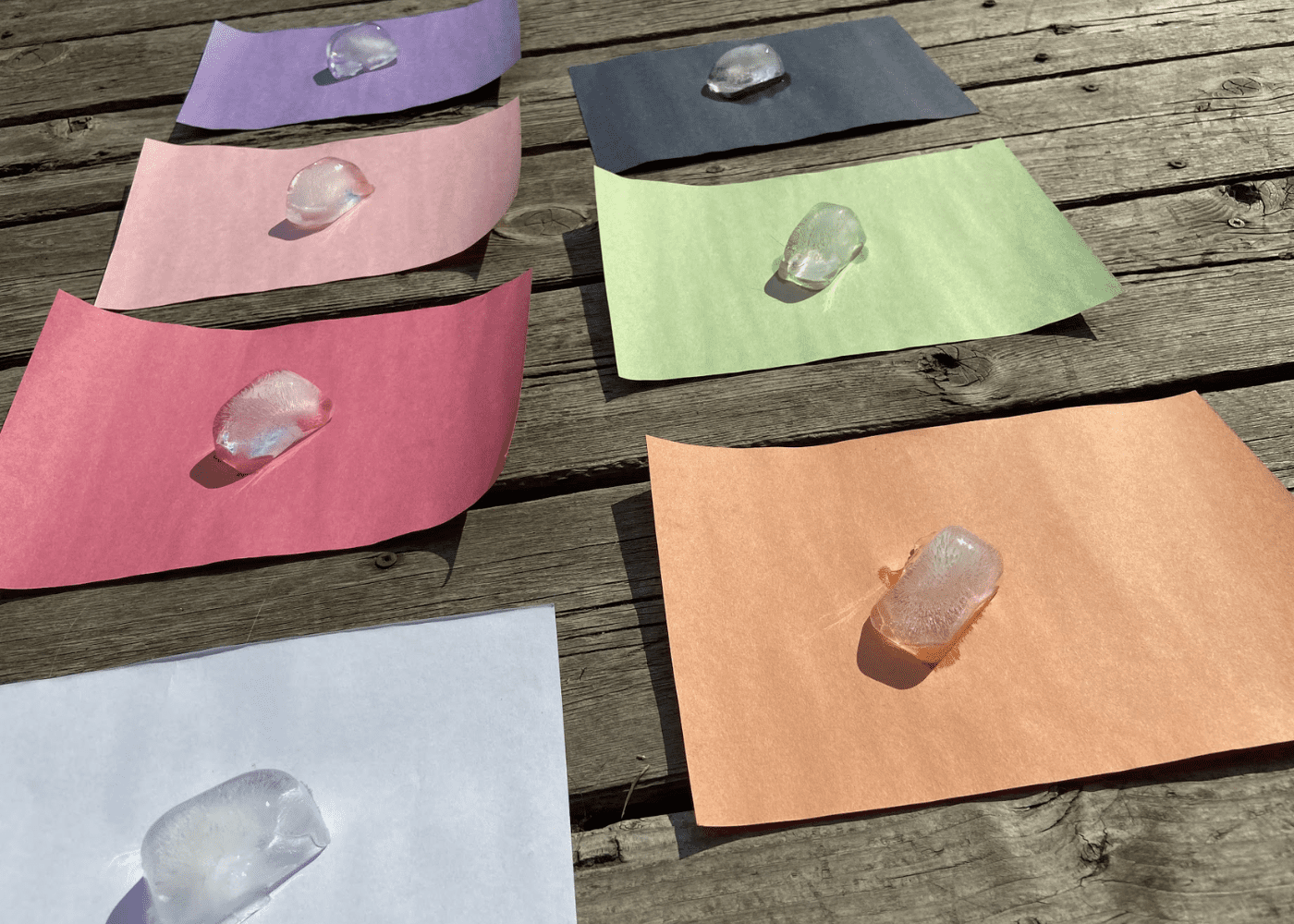
Color and heat go together in a way that’s easy to see once you know what to look for. This simple experiment uses paper and ice cubes to show kids exactly how color affects heat absorption. It works well outdoors on a sunny day, and it takes almost no prep. If you’re looking for science activities for preschoolers, this one is a solid choice.
This experiment is also featured in our roundup of 50 simple science experiments for kids, and it pairs well with our post on what melts ice the fastest.
Why color affects heat absorption
Most of us have had the experience of stepping onto dark asphalt on a hot summer day. That burning sensation underfoot is not a coincidence. Dark colors absorb more heat than light colors, and there is real science behind it.
Visible light is made up of all the colors of the rainbow. Every color we see corresponds to a different wavelength of light. When light hits an object, one of three things happens: the light is reflected, absorbed, or passes through the object.
A black object absorbs all wavelengths of light and reflects none. Because light energy converts into heat energy when it is absorbed, a black object takes in more heat than any other color. A white object does the opposite. It reflects all wavelengths back, which is why white objects stay cooler in the sun.
Colors in between, like red, blue, or green, absorb some wavelengths and reflect others. A red apple, for example, reflects red light back to your eyes and absorbs everything else. That means it absorbs more heat than a white object but less than a black one.
Shade matters too. A dark navy blue will absorb more heat than a pale sky blue, even though both are the same color family. The darker the color, the more heat it takes in.
What you need for this experiment
This experiment requires very little. You need seven ice cubes, seven sheets of different colored paper, and a hot sunny day. Construction paper cut to roughly half a standard sheet works well. Try to include white and black in your color selection, since those two extremes make the results easy to see. If you don’t have every color of the rainbow on hand, that is perfectly fine. Use whatever colors you have available.
Free printable worksheet
If you want to use this as a more structured learning activity, there is a free worksheet available to go along with it. You can download the individual worksheet as a PDF, or visit the Teachers Pay Teachers store to get the full “Don’t Melt the Ice” STEM challenge and worksheet bundle at no cost. There is also a free scientific method worksheet available in the shop if you want kids to walk through the full process of forming a hypothesis, recording observations, and drawing conclusions.
How to set up the experiment
Place one ice cube on each sheet of colored paper. Set all the papers outside in a spot that gets direct sunlight. Make sure they are all in the same location so that each ice cube gets the same amount of sun exposure. Record the time you started.
Check on the ice every few minutes. Keep track of which ice cube melts first, second, third, and so on. Write down what you observe. Encourage kids to guess ahead of time which color they think will melt the ice fastest, and then compare their prediction to what actually happens.
What the results show
The ice cube on the black paper will melt first. The ice cube on the white paper will melt last. Everything in between will fall somewhere in the middle, with darker shades melting faster than lighter ones.
This result is reliable because all the conditions are the same. The ice cubes start at the same size. They sit in the same sunlight. The only variable is the color of the paper underneath. That makes it easy for kids to connect the outcome directly to the color difference.
The experiment confirms what the science tells us. Black absorbs the most heat. White absorbs the least. Every other color falls somewhere along that spectrum depending on how dark or light it is.
Why this experiment works well for young kids
Young children learn best when they can see and touch the results of an idea. Abstract concepts like light wavelengths are hard to grasp from a textbook alone. But when a child watches an ice cube disappear faster on a black sheet of paper than on a white one, the idea clicks in a concrete way.
This activity also builds early observation and comparison skills that carry over into many other areas of learning. Kids practice forming predictions, watching for changes, and talking through what they noticed. Those habits are worth building early.
The outdoor setting helps too. Getting outside to do science makes the activity feel less like a lesson and more like play. If you want more ideas for learning outside, our outdoor learning section has plenty to choose from.
Extending the activity
Once kids have seen the basic results, you can push the experiment a little further. Try using two shades of the same color, like light blue and dark blue, to show that shade matters just as much as the color itself. You can also try different materials, like fabric or metal, to see whether the same color rule applies across surfaces.
Another option is to pair this experiment with the best insulation to keep ice from melting experiment. That activity flips the question around and asks kids to figure out how to protect an ice cube rather than melt it. Together, the two experiments give kids a fuller picture of how heat moves and how materials respond to it.
For more hands-on ideas, the full science for kids section has experiments and activities sorted by age and topic.





Leave a Reply to Vivek Cancel reply