
Preschool is a great time to introduce kids to science. They are curious, hands-on, and not yet worried about getting the “right” answer. That makes them natural scientists. These activities build on that curiosity with simple materials you likely already have at home.
Each activity here connects to a real science concept, but the goal is not a formal lesson. The goal is to let kids observe, wonder, and try things out. If you want to take things further, I put together a free Scientific Method Worksheet you can download and fill out together. It is a nice way to record what you tried and what happened, especially if you want to repeat an experiment later.
If you are looking for even more ideas beyond this list, we have a post covering 50 simple science experiments for kids of all ages.
Water science experiments
Water is one of the best materials for early science exploration. It is sensory, forgiving, and easy to set up. These experiments work well indoors or outside, and most require very little prep.
Sink or float
This is one of the simplest experiments you can do, and kids genuinely love it. Gather a mix of small items from around the house or yard. Fill a bin or bucket with lukewarm water, then drop items in one at a time. Before each item goes in, ask your child what they think will happen. This small step builds prediction skills and makes the result feel more satisfying.
Use the experiment to introduce the word “buoyancy” in a simple way. You do not need a long explanation. Just say something like, “Some things float because the water pushes up on them hard enough to hold them up.” For extra fun, make small boats out of tinfoil and see how many items you can load before the boat sinks. You can read more about this activity in our dedicated sink or float experiment post.
Ice excavation
This one takes a little planning, but the payoff is worth it. Fill a container with water and drop in small toys, dinosaur figures, plastic animals, or even Lego bricks. Freeze it overnight. The next day, set the ice block in a tray and give your child some tools to work with. Wooden skewers, small shovels, spray bottles filled with water, and a bowl of salt all work well.
Kids love chipping and spraying away at the ice to uncover what is hidden inside. It connects loosely to archaeology and geology, and it gives them a long stretch of focused, independent play. Our full ice excavation activity post has all the details if you want to try it.
Walking water
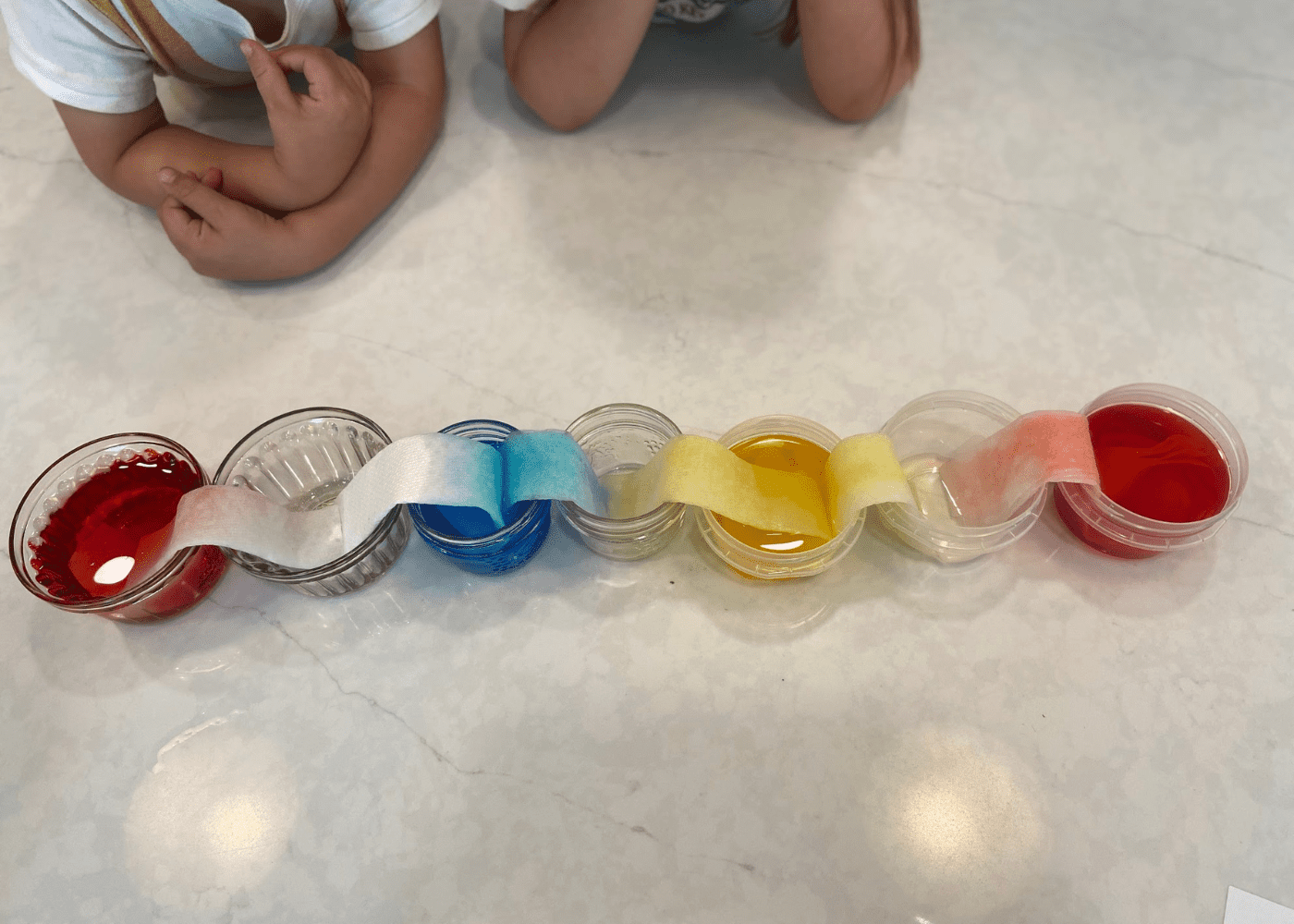
This experiment teaches kids about capillary action, which is how water moves through materials like paper towels. It also produces a visual surprise: two colors mix together in a third cup without anyone touching them. Set up cups of colored water connected by folded paper towel strips, and watch the water slowly travel and blend. Kids often think it looks like a magic trick. Our walking water experiment post walks you through the setup step by step.
DIY rain gauge
This one is fast to make and satisfying to use over time. Take an empty plastic bottle, cut off the top, and use a marker to add measurement lines along the side. Set it outside before a rainstorm and check it together afterward. It opens up natural conversations about weather and measurement. Our DIY rain gauge post has the full instructions.
Solar science experiments
Sun-based activities are a natural fit for outdoor learning. They require no special materials and they change throughout the day, which keeps kids coming back to observe.
Shadow drawing
Ask your child to gather a few small toys and set them on a piece of paper outside. Have them trace the shadows with a crayon or marker. Then move the toys to a different spot and trace again. The shapes and lengths will be different depending on where the sun is in the sky. This combines art and science in a way that feels very low-pressure. It is also a good follow-up to the ice excavation activity if you want to reuse the same toys. See our full shadow drawing for kids post for more ideas.
Homemade sundial
A sundial is a simple tool that shows how the sun moves across the sky throughout the day. You only need a circular base and a vertical stick to make a basic version. Mark where the shadow falls every hour. By the end of the day, your child will have a clear visual record of the sun’s movement. Talking about how people used sundials before clocks existed makes it feel like a real discovery. PBS has a helpful guide for setting this up at home.
S’mores solar oven
A DIY solar oven uses reflected sunlight to generate heat, and it is warm enough to melt chocolate and marshmallows on a sunny day. The Little Passports tutorial is a good one to follow. Combining cooking with solar energy makes the concept feel very concrete. Just keep napkins close by.
Color and melting rates
Place strips of different colored construction paper on a tray of ice cubes in direct sunlight. Ask your child which color they think will melt the ice fastest. Set a timer and observe. Dark colors, especially black, absorb more heat and melt ice faster than light colors do. This is a good experiment to pair with the scientific method worksheet since you can write down predictions and results. Our post on which color absorbs the most heat goes deeper into the science behind it.
Wind science activities
Wind is invisible, which makes it an interesting subject for preschoolers. These activities help kids observe something they cannot see directly by looking at what it does.
DIY kite
A homemade kite only needs a few sticks, string, and some kind of material for the sail, like a plastic bag or tissue paper. PBS has a straightforward tutorial for a basic version. If you are doing this with more than one child, compare the kites and talk about why one might fly better than another. Asking “why do you think that is?” is often enough to get a real conversation going.
Anemometer
An anemometer measures wind speed. The word is a mouthful for a preschooler, but the device itself is simple to build. You attach small cups to the ends of two crossed straws, balance them on a pencil, and watch them spin in the wind. The faster the wind blows, the faster it spins. DIY Project has a clear video tutorial that is easy to follow.
Wind-powered boat
Building a small boat that moves using only wind is a satisfying engineering challenge for kids. Clearway has a simple tutorial with good prompts for talking about renewable energy while you build. Once the boat is done, test it in a bathtub, a plastic bin, or a shallow outdoor water source.
Earth science experiments
These activities connect kids to the natural world around them. They tend to work best outside, and they are a good fit for kids who like to dig, touch, and explore with their hands.
No-bake fossils
Fossils are endlessly fascinating to young children, and making a replica is easier than it sounds. Crafts by Amanda has a good tutorial using air-dry clay or a simple salt dough. Press leaves, shells, or plastic toy animals into the material and let it dry. The result looks surprisingly real, and kids love the process of pressing objects in to make an impression.
Volcano experiment
The classic baking soda and vinegar volcano is a staple for good reason. Kids never get tired of watching it erupt. You only need a cup or bottle, baking soda, vinegar, water, dish soap, and food coloring. Put the vinegar, water, and food coloring into the container. Mix baking soda with a little water to make a slurry, then pour it in and step back. Adding dish soap gives the eruption more foam and drama.
If you want to take it further, we turned this into a three-day project. On day one we made a paper mâché volcano shell. On day two we painted and decorated it. On day three we made it erupt. I have also done simpler versions using sand and packed snow. Every version has worked well. Our volcano experiment for kids post has the full instructions, and we also have a snow volcano experiment if you want to try the winter version.
Chemical reaction and physical change activities
These are often the most exciting experiments for preschoolers because something clearly and dramatically happens. The results are visible, which makes the science feel real and immediate.
Lava lamp
This experiment shows kids that oil and water do not mix, and that a chemical reaction can create movement. Fill a jar about two-thirds full of oil, add water to fill the rest, drop in a few drops of food coloring, and then drop in half an Alka-Seltzer tablet. The colored water will bubble up through the oil in globs, just like a lava lamp. You can experiment with warm versus cold water to see if the temperature changes the reaction. Our lava lamp experiment post covers this in more detail.
Self-inflating balloon
Stretch a balloon over the top of a bottle that has a baking soda and vinegar mixture inside it. The gas produced by the reaction inflates the balloon without anyone blowing into it. It is a simple, clear demonstration of how chemical reactions can release energy. Our self-inflating balloon experiment post walks through the setup.
Salt and ice
Salt lowers the freezing point of water, which means it causes ice to melt faster. You can demonstrate this simply by sprinkling salt on part of an ice block and leaving the other part plain. Kids can observe the difference over time. Paging Fun Mums has a good detailed version of this activity if you want more guidance on how to set it up.
Oobleck
Oobleck is a mixture of cornstarch and water that behaves like both a solid and a liquid depending on how you handle it. Press on it firmly and it feels solid. Pick it up slowly and it drips like liquid. It introduces kids to the concept of states of matter in a way they can feel with their hands. It is messy but easy to clean up with water. Our oobleck recipe post has the full instructions and ratios.
A few more activities worth trying
The static electricity experiment is a good one if you want to combine science with a simple craft. You build a paper butterfly, then use a charged balloon to make the wings flutter. It is a memorable way to make an invisible force visible.
A five senses nature walk is another low-prep option that works well for preschoolers. Head outside and encourage your child to notice what they hear, smell, touch, see, and possibly taste (with careful supervision). Our 5 senses nature walk worksheet is a free printable you can bring along, or you can just work through it verbally as you walk.
If you are looking for more ideas in this space, our full science for kids section has a growing collection of experiments, activities, and printables organized by topic. There is always something new to try, and most of it requires very little setup or special equipment.
Science at this age is really just about paying attention and asking questions. These activities give kids a structure for doing that, but the curiosity is already there. You just need to point it in a direction and get out of the way.




Leave a Reply