
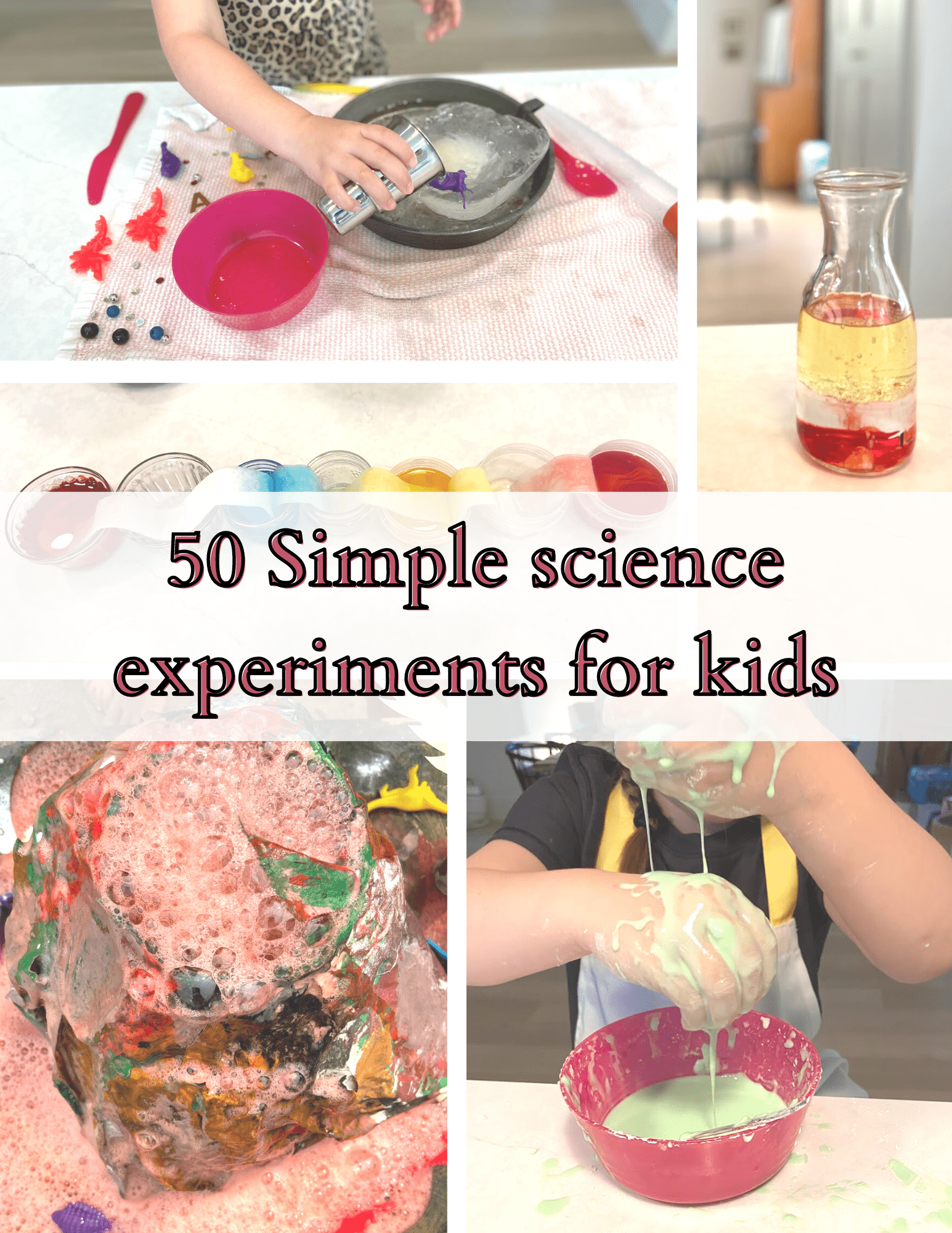
Science experiments are one of the best ways to get kids genuinely curious about the world. They ask questions, make predictions, and figure out what actually happens. That process matters just as much as the result. Whether you have five minutes or an afternoon, there is something on this list that will work for your family.
These 50 experiments are organized by age and skill level. The first group works well for kids in kindergarten through second grade. The second group is better suited for grades three through six, where the concepts get a bit more abstract and the projects more involved. Many of them overlap, so use your judgment based on your child.
Adult supervision is important for all of these, especially anything involving heat, sharp tools, or chemical reactions. Before you get started, you may also want to print a simple scientific method worksheet so kids can write down their hypothesis, observations, and conclusions. Practicing that process early builds real thinking skills.
Science experiments for grades K to 2
These experiments use easy-to-find materials and introduce concepts in a hands-on way. Younger kids may not fully grasp the science behind everything, but that is okay. Building curiosity and a willingness to experiment is the whole point at this age. Many of these also work well for preschool-aged children with close supervision.
1. Oobleck
Mix cornstarch and water to make a substance that acts like both a liquid and a solid. It is a simple introduction to states of matter and the full recipe and instructions are here.
2. String telephone
Two cups connected by a piece of string teach kids how sound waves travel. This classic experiment needs nothing more than supplies from your recycling bin.
3. DIY dam
Kids build their own dam using whatever materials they can find. It is a great introduction to environmental science and engineering thinking.
4. Popsicle stick catapult
All you need is a few popsicle sticks, a rubber band, a plastic spoon, and something small to launch. Kids learn about force and motion while building something they can actually play with.
5. Walking water experiment
This experiment combines color mixing with capillary action. Water travels between cups through paper towels and creates new colors along the way. Find the full tutorial here.
6. Grow a windowsill garden
Use an empty plastic bottle or egg carton to start seedlings indoors. Kids observe plant growth over time and learn about what plants need to survive.
7. Seed germination in a bag
Skip the dirt and tape a damp paper towel with seeds inside a zip-lock bag to a sunny window. Kids can watch the roots and sprouts form without digging anything up.
8. Rock candy
This takes a few days, but kids get to watch sugar crystals form and then eat the result. It is a great way to introduce the concept of crystallization.
9. Pepper and soap experiment
Sprinkle pepper on a bowl of water, then touch the surface with a soapy fingertip. The pepper scatters immediately. This demonstrates surface tension and the hydrophobic nature of soap.
10. Baking soda volcano
A classic for a reason. Kids mix baking soda and vinegar to create a chemical reaction that produces carbon dioxide. See how to make one here.
11. Ice cream in a bag
Combine cream, sugar, and flavoring in a small bag, then place that bag inside a larger one filled with ice and salt. Shake it until ice cream forms. It is a hands-on lesson in states of matter that ends in a snack.
12. Invisible ink
Use lemon juice, turmeric, or baking soda to write secret messages that only appear when heat or another substance is applied. Kids learn about chemical reactions in a fun, low-stakes way.
13. Static electricity experiment
Rub a balloon on hair or a wool sweater and watch it attract small objects or make paper butterflies dance. The full tutorial is here.
14. Homemade sundial
Place a stick in the ground and mark where the shadow falls throughout the day. Kids see firsthand how the sun moves and how people used to tell time before clocks existed.
15. Shadow drawing
Set a toy or object outside in the sun and trace its shadow at different times of day. This is both a science activity and a simple art project. See how to do it here.
16. Sink or float
Fill a tub or basin with water and gather a variety of household objects. Before dropping each one in, have kids predict whether it will sink or float. This experiment works well for practicing the scientific method.
17. Floating egg
Place an egg in a glass of plain water, then slowly add salt. At some point, the egg will begin to float. Kids learn about how dissolved salt changes the density of water.
18. Color-changing flowers
Put white flowers or celery stalks in water tinted with food coloring. Check back a few hours later to see the color travel up through the plant. This shows how plants absorb water through capillary action.
19. Surface tension experiments
Test surface tension with a variety of simple setups. Try floating a paperclip on water, or adding a drop of dish soap to a bowl of milk with food coloring swirled in. The soap breaks the surface tension and the colors move.
20. Bouncing egg
Soak a raw egg in vinegar for a few days. The shell dissolves and the egg becomes rubbery and slightly bouncy. Test it carefully over a surface outside.
21. Coffee ground fossils
Mix coffee grounds, flour, salt, and water to create a moldable dough. Press leaves, shells, or small toys into it to make impressions. Once dry, kids have their own fossils to examine.
22. Color and ice melting
Place ice cubes on squares of different colored paper or fabric in the sun. Track which color causes the ice to melt fastest. This connects to the concept of heat absorption.
23. DIY anemometer
Build a simple wind speed measuring tool using paper cups, straws, and a pencil. Kids can take it outside and compare readings on windy and calm days.
24. Ice excavation
Freeze small toys or objects inside a block of ice, then give kids tools like spoons or warm water to excavate them. It is a great summer activity that teaches kids about heat and melting.
25. Candy engineering
Give kids toothpicks and small candies like gumdrops or marshmallows and challenge them to build the tallest or strongest structure they can. Then they get to eat their building materials.
26. Soap soufflé
Place a bar of Ivory soap in the microwave and watch it expand dramatically. The heat causes trapped air bubbles to expand, and the soap puffs up like a cloud. It is still fully usable afterward.
27. Regrow food scraps
Save the base of green onions or the top of a carrot and place them in shallow water near a window. Watch them regrow over the next week. This is a simple introduction to plant life cycles.
28. DIY lava lamp
Fill a jar with water, vegetable oil, and food coloring. Drop in an Alka-Seltzer tablet and watch the reaction. The carbon dioxide gas carries drops of colored water up through the oil. Full instructions are here.
29. Homemade rain gauge
Cut a plastic bottle in half and invert the top into the base to create a simple rain gauge. Place it outside and track rainfall over time. This tutorial walks you through it step by step.
Science experiments for grades 3 to 6
These projects involve more precise measuring, more complex concepts, or multi-step processes. Older kids will get more out of the science behind each one, though many could still be adapted for younger children with extra support.
30. Self-inflating balloon
Mix baking soda and vinegar inside a bottle with a balloon stretched over the opening. The carbon dioxide produced by the reaction inflates the balloon without anyone blowing into it. See the full experiment here.
31. Plaster fossil
Use plaster of Paris and a shell or plastic animal to make a mold and cast. Once dry, the result looks like a real fossil. Brushing cold coffee over the dried surface makes it look even more realistic.
32. Ice insulation challenge
Challenge kids to design their own insulating container using household materials. The goal is to keep an ice cube from melting for as long as possible. This concept connects to real-world engineering.
33. Egg drop challenge
Design a container using materials like straws, tape, and bubble wrap that can protect a raw egg from a fall. Test it by dropping it from a height. This teaches engineering design, force, and impact.
34. Plant water filtration
Use sand, gravel, and soil to build a simple water filter in a plastic bottle. Pour dirty water through and observe how the layers remove particles. This shows why plants and soil matter in natural water filtration.
35. Rube Goldberg machine
A Rube Goldberg machine uses a chain of events to complete a simple task in the most complicated way possible. Challenge kids to design one using household items. It teaches cause and effect, energy transfer, and creative problem solving.
36. Pendulum painting
Hang a cup with a small hole over paper, fill it with paint, and let it swing. The patterns it creates reflect the physics of a pendulum. This one can get messy, so do it outside or on a drop cloth.
37. DIY water wheel
Build a simple water wheel using cardboard or foam and test it under running water. Kids learn about how flowing water can generate mechanical energy.
38. Handmade paper
Soak scrap paper in water, blend it, and press it into sheets to dry. Kids learn about fiber, texture, and the basic process behind papermaking.
39. Balloon rockets
Thread a balloon onto a string stretched across the room. Blow up the balloon, hold the end closed, then release it. The air escaping propels the balloon forward. This is a simple demonstration of Newton’s third law of motion.
40. Slime
Making slime introduces kids to polymers and viscosity. The ingredients form long chains of molecules that give slime its stretchy, thick texture. Younger kids enjoy it too, though the science behind it is better suited to older learners.
41. Vibrating molecules and temperature
Drop food coloring into hot water and cold water and compare how quickly it spreads. The color diffuses faster in hot water because the molecules are moving more quickly. It is a simple and visual way to introduce thermal energy.
42. Solar oven
Line a pizza box with foil and plastic wrap to trap heat from the sun. Use it to melt chocolate and marshmallows. Kids learn about solar energy and heat transfer while making a snack.
43. DIY seismograph
Build a simple seismograph using a cardboard box, a hanging weight, and a marker. When the table shakes, the marker traces the movement on paper. It works on the same basic principle as real seismograph equipment.
44. Paper plane aerodynamics challenge
Design, fold, and test paper planes with different shapes and wing sizes. Track which designs fly the farthest or most accurately. Kids learn about lift, drag, thrust, and gravity in a hands-on way.
45. DIY paper plane launcher
Build a simple launcher from rubber bands and cardboard to send paper planes even farther. Adding the launcher changes the variables, so kids can test distance with and without it and compare the results.
46. Extract iron from cereal
Crush iron-fortified cereal and mix it with water, then pass a strong magnet over the surface. Small iron particles will cling to the magnet. It is a surprising and memorable way to show kids that iron in food is real and physical.
47. Thermal energy and balloons
Blow up a balloon and hold it near a candle flame. It pops quickly. Then fill a balloon partially with water before inflating it and repeat the test. The water absorbs the heat and the balloon does not pop. This shows how different materials transfer thermal energy.
48. Simple electric motor
Use a battery, a magnet, and a coil of copper wire to build a motor that spins on its own. It takes some patience to get the alignment right, but seeing it spin is a satisfying payoff.
49. Saltwater density layers
Add varying amounts of salt to cups of colored water. Then carefully layer them in a clear glass by pouring the densest layer first. The colors stack without mixing, showing how differences in density allow liquids to layer.
50. Grow mineral crystals
Dissolve Borax in hot water and suspend a pipe cleaner shape in the solution overnight. By morning, crystals will have formed on the surface. This teaches kids about saturation, solubility, and recrystallization. Note that Borax is not safe to ingest, so this one requires close supervision and is best suited to older children.
Making the most of these experiments
The experiments themselves are fun, but the learning happens when kids slow down and think through what they observed. Encourage them to make a prediction before starting and explain what they noticed when it is finished. Even a simple question like “why do you think that happened?” goes a long way.
If your child is working through more structured science learning, these experiments pair well with worksheets, nature journals, or reading. You do not




Leave a Reply